
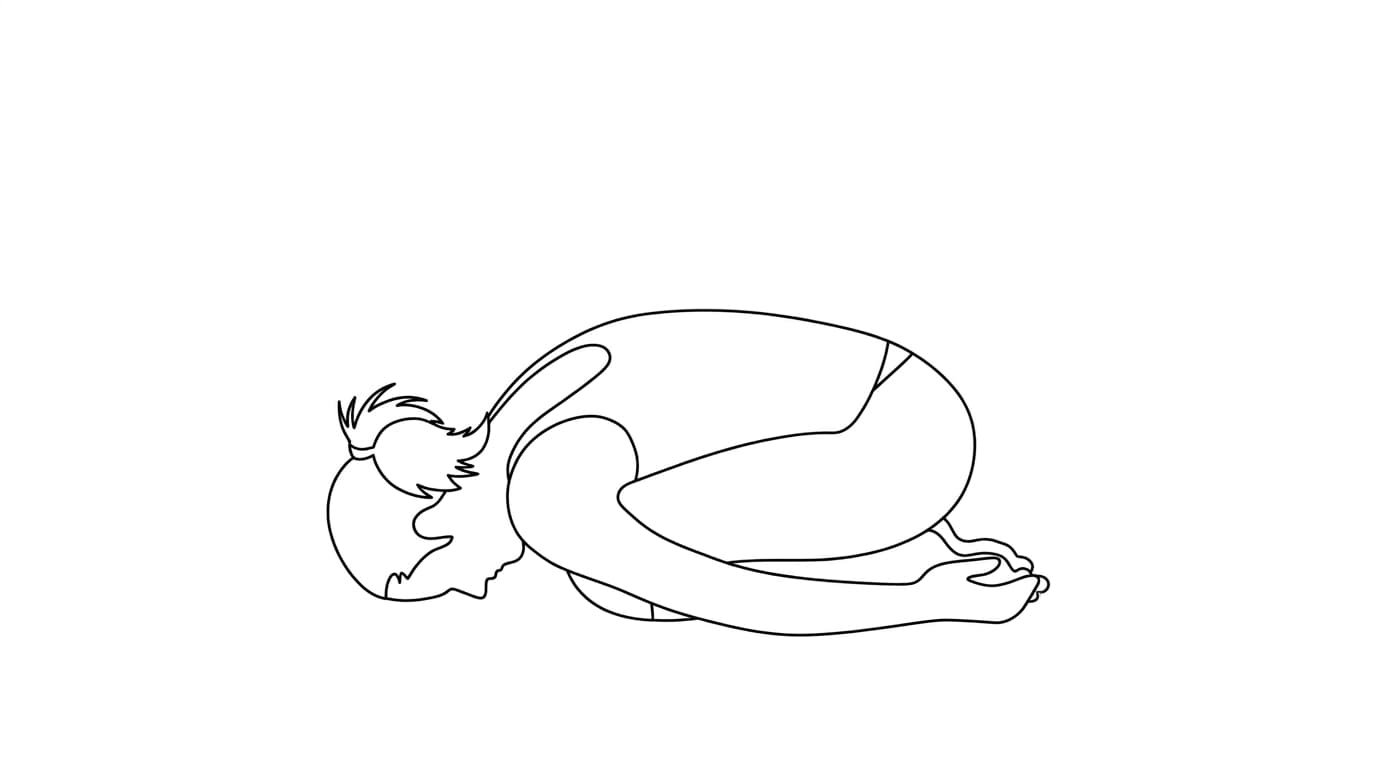
Balasana, often called Child’s Pose, is a kneeling shape in which the torso folds toward the thighs. The knees may be together or apart, and support under the torso or head can make the position more comfortable.
What is Child’s Pose?
Child’s Pose is commonly used as a resting or transition shape, but it does not feel restful for everyone. The distance between the knees and the amount of support can be adjusted.
The aim here is a position that allows an unforced breath. There is no need to press the hips toward the heels.
How do you practice Child’s Pose?
Move slowly, keep the breath comfortable, and use the version that feels stable for your body today.
- Begin kneeling on a padded surface, with the knees together or comfortably apart.
- Move the hips back only as far as feels comfortable. Place a folded blanket between the hips and heels if there is a gap or pressure.
- Fold the torso forward and rest the forehead on the floor, a block, or folded arms.
- Let the arms rest forward or alongside the legs. Breathe naturally and come out slowly by pressing the hands down.
Alignment cues
- Support the head so the neck can relax.
- Let the knees move wider if that gives the torso more room.
- Keep breathing easy; do not force the hips down.
Modifications
- Place a bolster or stacked blankets under the chest and head.
- Pad the knees and ankles, or use a folded blanket between the thighs and calves.
- Choose a seated rest instead if kneeling or folding is uncomfortable.
Variations
- Arms-forward Child’s Pose.
- Arms-by-sides resting variation.
- Supported Child’s Pose with a bolster beneath the torso.
Common mistakes
- Forcing the hips toward the heels.
- Letting the head hang without support.
- Treating the pose as mandatory rest when it causes discomfort.
Safety notes
- Use care with knee, ankle, or hip discomfort and change the position rather than forcing the joints.
- If the folded position restricts breathing or feels uncomfortable, come upright and choose another resting posture.
- General yoga safety guidance is available from NCCIH; this page cannot assess an individual injury.
Common questions
Do my knees need to stay together?
No. Keep them together or separate them to a comfortable width. A wider stance may make room for the torso.
What if my hips do not reach my heels?
That is fine. Support the space with a folded blanket or cushion; do not force the hips down.
References and further reading
These references provide general context. They do not validate every cue on this page or replace instruction from a qualified teacher.
- Yoga: Effectiveness and Safety National Center for Complementary and Integrative Health (NCCIH). General background on yoga research, common injury considerations, and when to seek individualized guidance. It is not a pose-specific clinical assessment.