
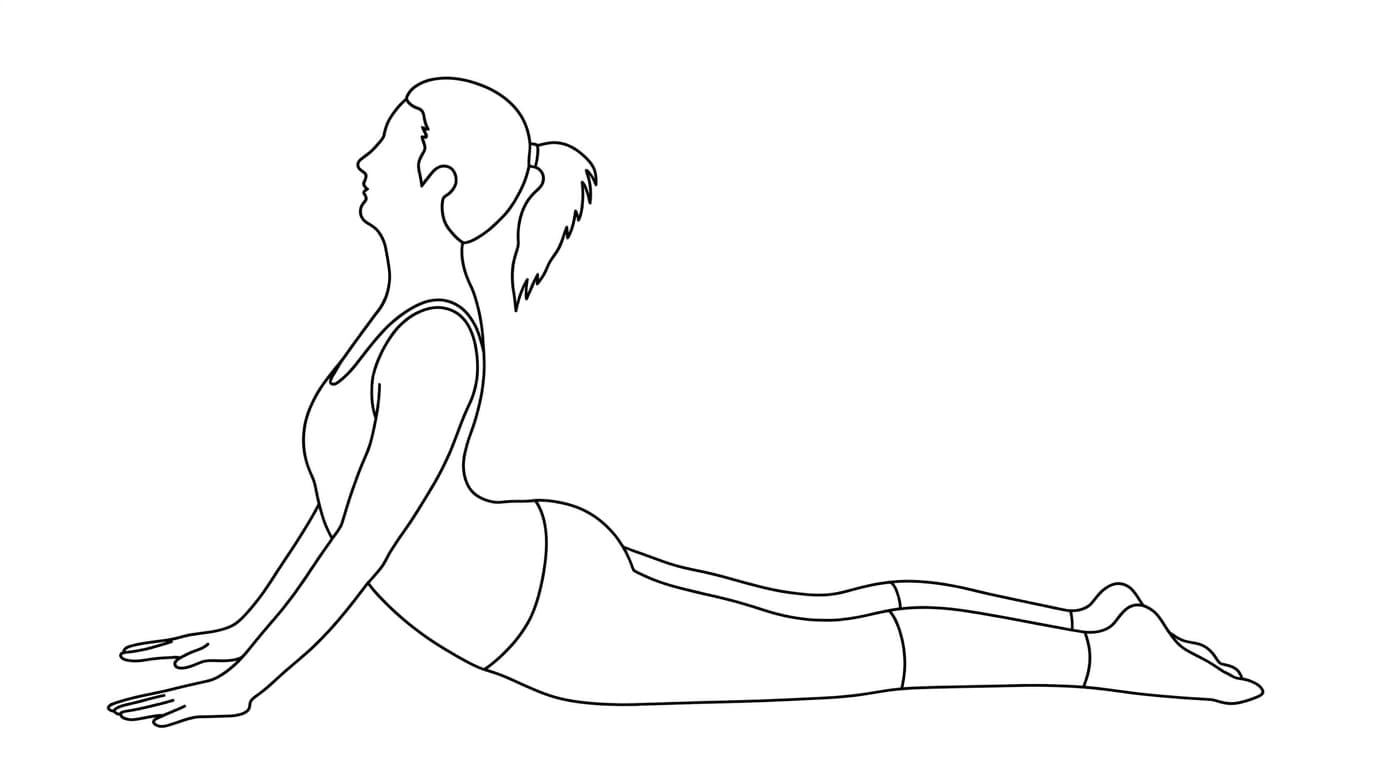
Bhujangasana, or Cobra Pose, is a prone backbend in which the chest lifts while the pelvis, legs, and tops of the feet remain supported on the floor. A low version keeps the elbows bent and the neck comfortable. Lift only within a range that allows easy, unforced breathing.
What is Cobra Pose?
Cobra Pose is a prone backbend, not a requirement to reach a particular height. In a small lift, the back muscles help raise the chest and the arms may provide light support. A higher version is not automatically a better version.
YogaBasics' Cobra Pose instructions describe a prone chest lift with the pelvis grounded. This guide focuses on a low version and is general educational information, not individualized instruction.
How do you practice Cobra Pose?
Move slowly, keep the breath comfortable, and use the version that feels stable for your body today.
- Lie on your front with the legs comfortably extended. Let the tops of the feet rest on the floor and keep the back of the neck long.
- Place your hands beside the lower ribs, with elbows bent and drawing toward the sides of the body. Let the shoulders settle away from the ears.
- As you inhale, gently draw the chest forward and slightly upward. Use the back muscles first; press into the hands only enough to support the movement.
- Keep the front of the pelvis grounded and stop at the first point where the shape feels steady and easy to breathe in. The elbows can remain bent.
- Stay for a few comfortable breaths without holding them. Exhale and lower the chest slowly.
How should you breathe in Cobra Pose?
Let the breath remain comfortable rather than using a deep inhale to force a higher lift. You can lift with an easy inhalation, continue breathing naturally while holding the position, and lower with an exhalation.
No breath retention or fixed breathing ratio is required. If the position restricts breathing, reduce the lift or come down instead of trying to hold longer.
Alignment cues
- Think of lengthening the front of the body rather than pushing the ribs straight up.
- Keep the elbows close to the torso and the shoulders broad.
- Use a modest lift; do not force the arms straight or turn the head sharply upward.
What is Cobra Pose commonly practiced for?
Cobra Pose is commonly used to explore a controlled backbend and coordinate movement with breathing. The practice does not require a large range of motion or a particular physical result.
Research about yoga programs is not proof of a health benefit from this individual pose. The references cited here do not establish Cobra Pose as a treatment for back pain or as a way to change organ, hormone, or energy-system function.
Modifications
- For a smaller range, keep the hands light and lift the chest only a little, or leave the chest down and practice lengthening the spine.
- If the wrists dislike bearing weight, rest the arms beside the body and make a very small chest lift, provided it remains comfortable.
- Sphinx Pose is a related option using the forearms for support. Reduce the height or stop if the lower back feels compressed; forearm support does not make the pose suitable for everyone.
Variations
- Baby Cobra: a low lift with the hands helping very little.
- Sphinx Pose: the forearms support the upper body; it is a related prone backbend, not simply a higher Cobra.
- Higher Cobra: the chest rises farther while the elbows stay soft. Choose it only when the lower range is comfortable and controlled.
Common mistakes
- Pressing the hands hard and locking the elbows to gain height.
- Shrugging the shoulders toward the ears or letting them roll forward.
- Lifting the chin and compressing the back of the neck.
- Continuing when the lower back feels pinched or the breath becomes strained.
Safety notes
- Come out of the pose if you feel sharp pain, tingling, numbness, dizziness, or difficulty breathing. A stretch sensation is not a reason to push through pain.
- People with back, wrist, shoulder, or abdominal concerns, those recovering from surgery, and anyone who is pregnant should seek individualized guidance before practicing prone backbends.
- Yoga-related injury is possible. NCCIH advises learning with qualified instruction, adapting for individual needs, and not using yoga to postpone medical care.
How can you rest after Cobra Pose?
Lower the chest slowly and pause in a comfortable resting position. No particular counterpose is mandatory, and you do not need to force a deep forward bend to compensate for the backbend.
Child's Pose is one option if it is already familiar and comfortable for your knees, hips, and breathing. Otherwise, choose another comfortable rest and ask a qualified teacher about transitions that suit you.
Common questions
How high should I lift in Cobra Pose?
Only as high as you can stay comfortable and breathe smoothly. A small lift with bent elbows is a complete variation.
Should I straighten my arms?
No. Straight arms are not a goal in Cobra Pose. Keep a bend in the elbows if that lets you maintain a comfortable, controlled backbend.
Is Cobra Pose the same as Upward-Facing Dog?
No. In Cobra, the pelvis and legs remain grounded. In Upward-Facing Dog, the thighs and pelvis lift and the arms support more of the body. Do not assume one is an appropriate substitute for the other.
References and further reading
These references provide general context. They do not validate every cue on this page or replace instruction from a qualified teacher.
- Yoga: Effectiveness and Safety National Center for Complementary and Integrative Health (NCCIH). General background on yoga research, common injury considerations, and when to seek individualized guidance. It is not a pose-specific clinical assessment.
- Cobra Pose YogaBasics. Pose-specific positioning reference, not evidence for medical, hormonal, or energetic claims.