
Dhanurasana, or Bow Pose, is a prone backbend in which the hands hold the ankles while the chest and legs lift. It requires shoulder and back mobility; a smaller preparation or a different pose may be more appropriate.
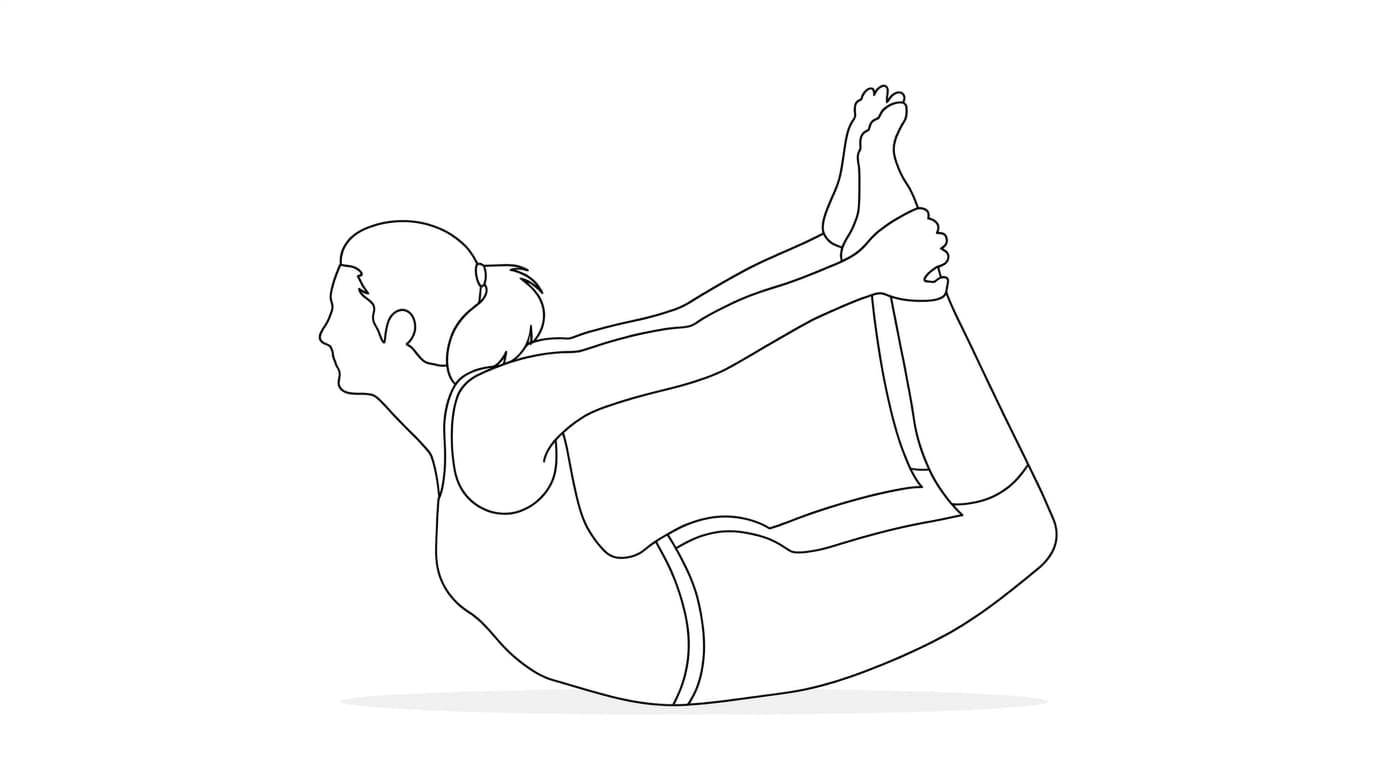
What is Bow Pose?
Bow Pose is a stronger backbend than a low Cobra variation. Do not pull the ankles to force the chest or thighs higher.
This general guide does not assess whether the pose suits an individual.
How do you practice Bow Pose?
Move slowly, keep the breath comfortable, and use the version that feels stable for your body today.
- Lie on the front with the forehead resting on the mat.
- Bend the knees only as far as comfortable. If reaching the ankles strains the shoulders or back, stop and choose a gentler variation.
- If the grip is easy and pain-free, hold the ankles without pulling.
- Keep the breath smooth and lift only a small amount if the shape remains comfortable.
- Release the ankles and lower slowly; rest before deciding whether to repeat.
Alignment cues
- Keep the knees no wider than feels comfortable.
- Avoid jerking the legs or pulling the ankles.
- Do not force the neck into extension.
Modifications
- Practice a gentle single-leg bend without gripping the ankle.
- Use a strap only with qualified instruction and without pulling.
- Choose Baby Cobra or Locust instead.
Variations
- Single-leg preparation.
- Gentle ankle-grip lift, only when comfortable.
Common mistakes
- Pulling hard on the feet.
- Forcing the knees together despite discomfort.
- Continuing when the lower back feels compressed.
Safety notes
- Skip for back, shoulder, knee, or abdominal concerns, pregnancy, or recent surgery unless an appropriate professional has advised otherwise.
- Stop for sharp pain, numbness, dizziness, or breath restriction.
Common questions
Is Bow Pose a beginner pose?
It can be challenging. Start with a smaller preparation or choose another backbend; do not force the ankle grip.
References and further reading
These references provide general context. They do not validate every cue on this page or replace instruction from a qualified teacher.
- Yoga: Effectiveness and Safety National Center for Complementary and Integrative Health (NCCIH). General background on yoga research, common injury considerations, and when to seek individualized guidance. It is not a pose-specific clinical assessment.