
Locust I is catalogued as Shalabhasana A. The gentle chest or single-leg lifts described here are low-range explorations, not a verified lineage-specific version of Locust I. Keep the movement controlled and stop if the back feels pinched.
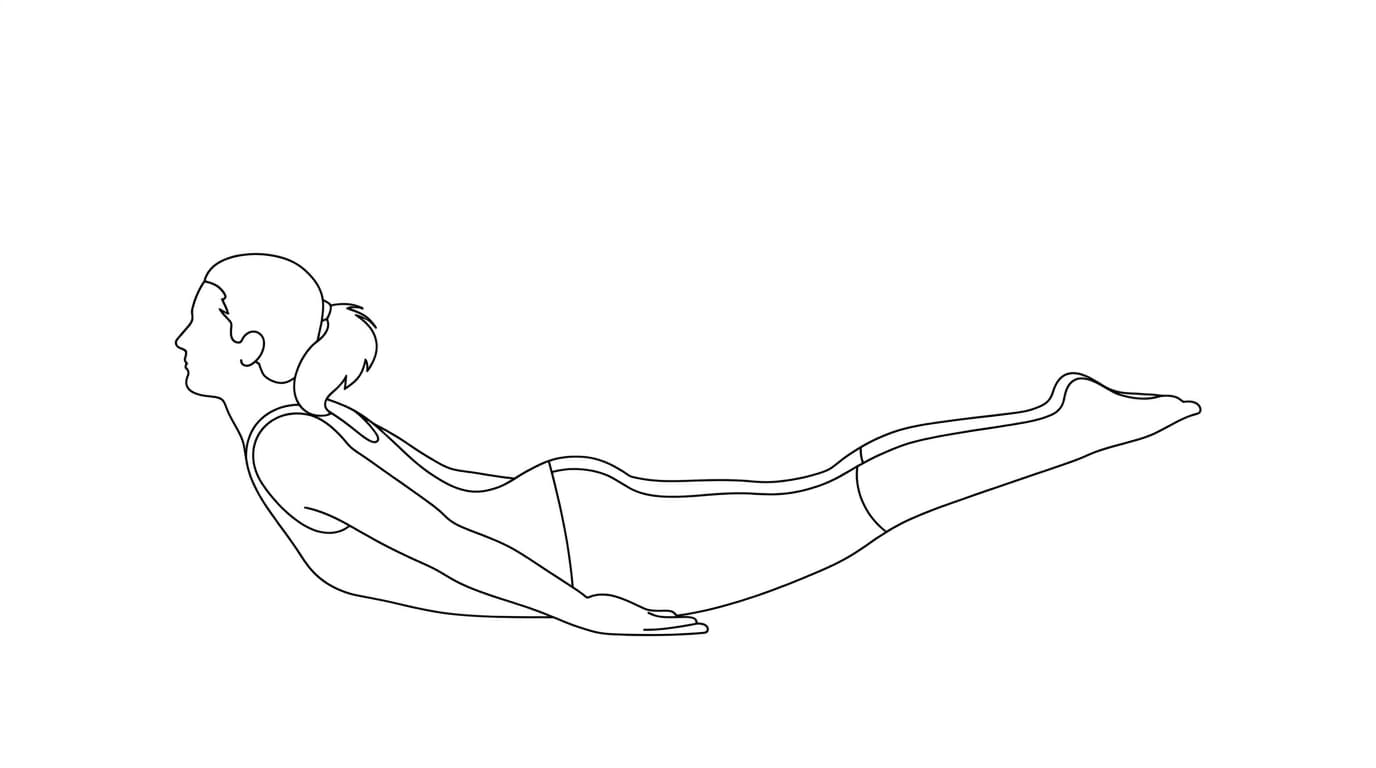
What is Locust I?
The catalog identifies this entry as Locust I (Shalabhasana A). Lettered forms vary among teaching sources. The gentle chest or single-leg lift below is a low-range exploration, not a claim that this is the definitive A-form setup.
Avoid using momentum or holding the breath.
How do you explore a low-range Locust preparation?
Move slowly, keep the breath comfortable, and use the version that feels stable for your body today.
- Lie on your front with the legs comfortably extended and the forehead supported.
- Rest the arms alongside the body, palms facing down or inward.
- Gently lengthen through the legs and lift the chest a small amount, or keep the chest down and lift one leg only if comfortable.
- Pause briefly while breathing naturally, then lower slowly.
- Rest before repeating or stop after one round.
Alignment cues
- Keep the back of the neck long.
- Use a small lift and keep the pelvis grounded.
- Avoid squeezing the lower back to gain height.
Modifications
- Keep the chest down and practice a single-leg lift.
- Place a folded blanket under the pelvis.
- Skip the lift and rest on the front with the head turned to one side.
Variations
- Small chest lift.
- Single-leg lift, one side at a time.
Common mistakes
- Swinging the limbs upward.
- Lifting too high and compressing the lower back.
- Holding the breath.
Safety notes
- Modify or skip for back, shoulder, or abdominal concerns, pregnancy, or recent surgery.
- Stop for sharp pain, tingling, or difficulty breathing.
Common questions
Do both legs have to lift in this preparation?
No. Keep the legs down or lift one leg at a time if that is comfortable.
References and further reading
These references provide general context. They do not validate every cue on this page or replace instruction from a qualified teacher.
- Locust I Pocket Yoga. Used to confirm this catalog entry's lettered name; its pose instructions are not reproduced here.
- Yoga: Effectiveness and Safety National Center for Complementary and Integrative Health (NCCIH). General background on yoga research, common injury considerations, and when to seek individualized guidance. It is not a pose-specific clinical assessment.