
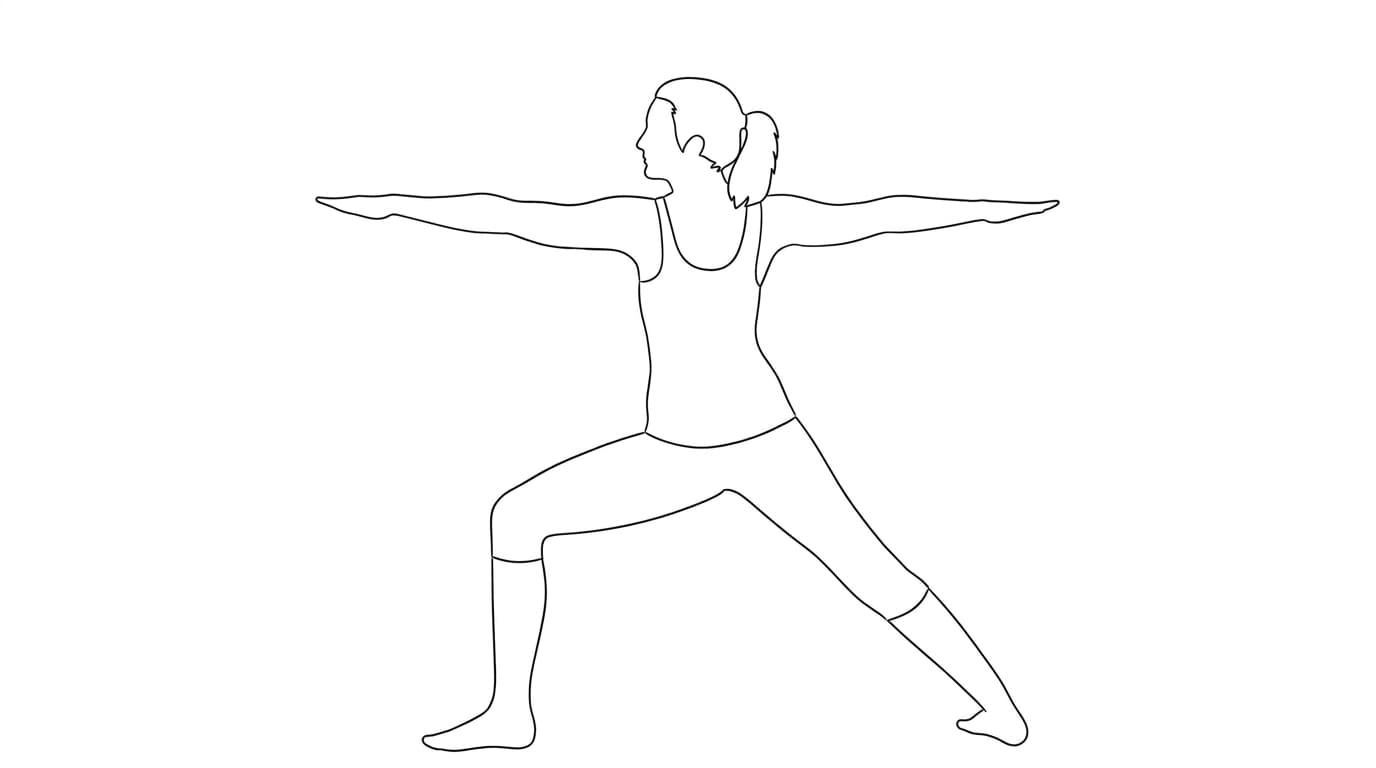
Warrior II is a wide standing lunge with one knee bent, the other leg extended, and the arms reaching in opposite directions. Adjust the stance width and knee bend so the position feels stable and does not strain the joints.
What is Warrior II?
Warrior II is a modern postural yoga shape named for the warrior Virabhadra in the yoga tradition. Practice it at a comfortable width rather than chasing a deep bend.
Use a wall or chair for balance support if needed.
How do you practice Warrior II?
Move slowly, keep the breath comfortable, and use the version that feels stable for your body today.
- Stand with feet comfortably wide and turn one foot outward while angling the other slightly inward.
- Bend the front knee only as far as comfortable, keeping the stance stable.
- Reach the arms out at shoulder height if the shoulders allow, with palms facing down.
- Keep the torso upright and gaze over the front hand only if the neck is comfortable.
- Straighten the front leg to exit, then turn the feet and repeat on the other side.
Alignment cues
- Keep the front knee tracking in the same general direction as the toes.
- Reduce the stance if the pelvis or knee feels strained.
- Let the shoulders stay relaxed rather than lifting the arms by force.
Modifications
- Shorten the stance and use a shallow knee bend.
- Rest the hands on the hips or place one hand on a chair.
- Practice with the back heel near a wall for orientation.
Variations
- Hands on hips.
- Chair-supported shallow lunge.
Common mistakes
- Taking a stance so wide that the knee or groin feels strained.
- Letting the front knee collapse inward.
- Holding the arms up despite shoulder discomfort.
Safety notes
- Adapt the stance for knee, hip, or balance concerns.
- Use a stable support and avoid forcing the front knee into a deep bend.
- NCCIH notes that people with preexisting injuries or balance issues may need pose modifications.
Common questions
How deep should the front knee bend?
Use a comfortable bend that lets the foot stay grounded and the knee feel steady. A shallow lunge is a valid variation.
References and further reading
These references provide general context. They do not validate every cue on this page or replace instruction from a qualified teacher.
- Yoga: Effectiveness and Safety National Center for Complementary and Integrative Health (NCCIH). General background on yoga research, common injury considerations, and when to seek individualized guidance. It is not a pose-specific clinical assessment.