
Two Legs Behind the Head II is an advanced variation involving both legs behind the head or shoulders. The specific form is lineage-dependent; do not force the knees, load the neck, or attempt the posture without qualified in-person guidance.
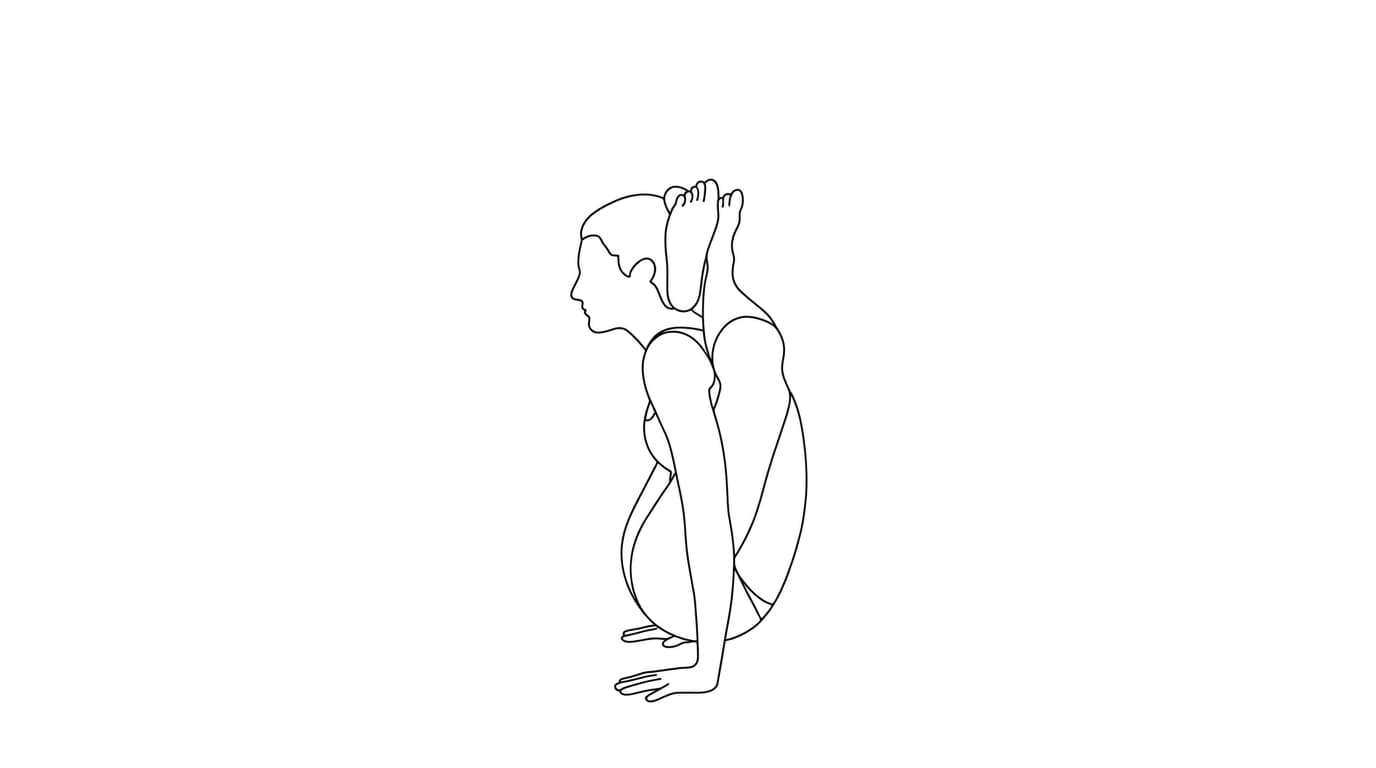
What is Two Legs Behind the Head II?
Dvi Pada Sirsasana B is a named advanced form in the leg-behind-head family. Catalog labels do not establish a universal entry method or safe readiness criteria.
How should this pose be approached?
This page intentionally provides no entry or exit sequence. Learn the exact form from a qualified teacher who can assess the hips, knees, and neck.
- Never pull the legs behind the head or use the neck to hold them.
- Avoid practicing the full form unsupervised.
- Stop immediately for pain, numbness, tingling, or breathing restriction.
- Choose a comfortable seated rest as an alternative.
What is a lower-demand alternative?
Use Easy Pose or another stable seated position. A teacher may suggest appropriate mobility work without leg-behind-head loading.
Common question: Does the B variation differ across schools?
Yes. Verify the specific form and instruction before practice.
References and further reading
These references provide general context. They do not validate every cue on this page or replace instruction from a qualified teacher.
- Yoga: Effectiveness and Safety National Center for Complementary and Integrative Health (NCCIH). General context on yoga safety; not pose-specific instruction or endorsement.