
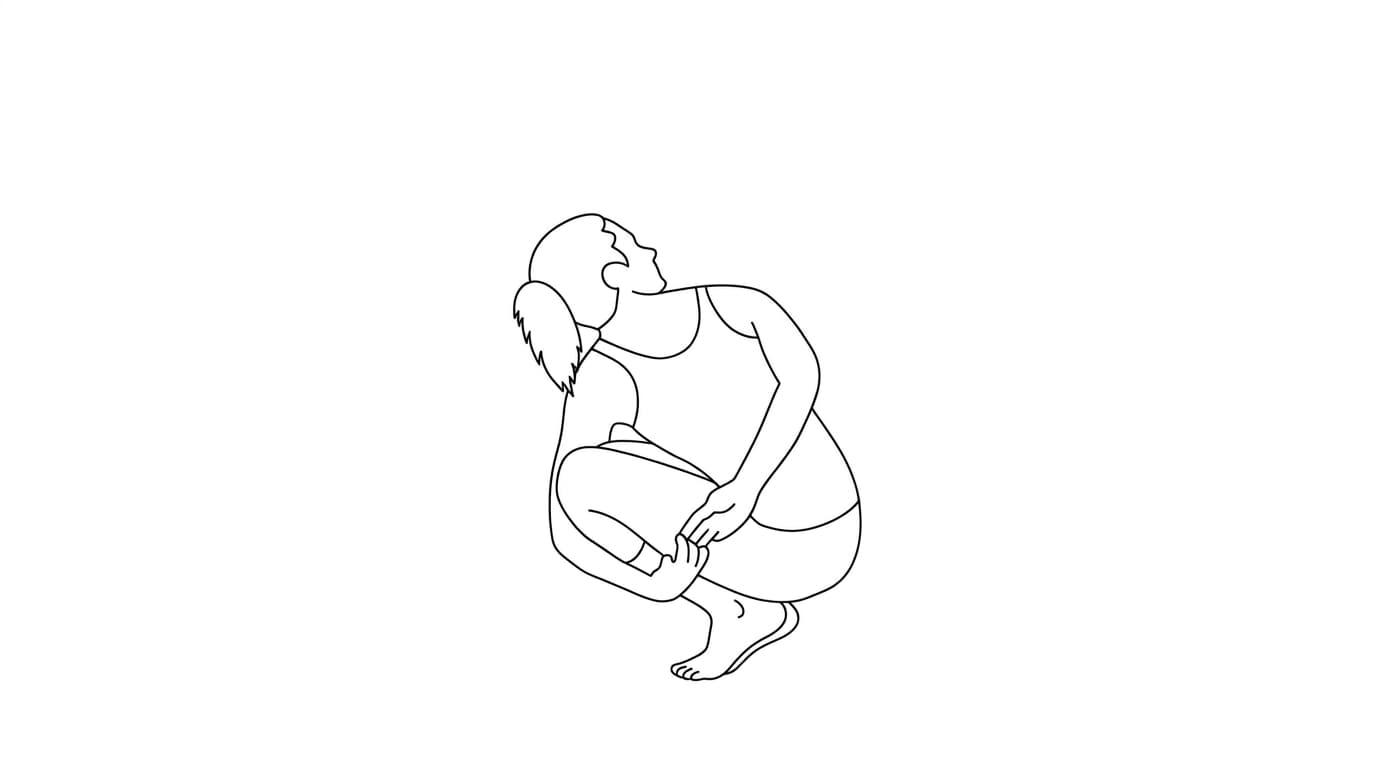
Noose Pose is a deep squat combined with a twisting arm bind. Both the squat and bind may challenge knees, ankles, shoulders, and balance; use a supported squat and do not force the full bind without direct instruction.
What is Noose Pose?
Pashasana is commonly described as a squat with a torso twist and arm bind. The full shape combines several demands and should be taught in person rather than assembled by forcing the arms around the legs.
How should the pose be approached?
First confirm the specific variation with a qualified teacher. This page does not prescribe the full bind or entry.
- Use a raised support under the seat for a comfortable squat.
- Keep the torso rotation small and the hands unbound during preparation.
- Do not use the arms to pull the knees or spine into position.
- Leave the posture for pain, numbness, or instability.
What is a simpler alternative?
Practice a supported Garland Pose or a gentle seated twist with both feet grounded.
Common question: Is the bind necessary to get the benefit?
The bind is part of the full form, but it is not appropriate to force. A supported squat or twist is a valid alternative.
References and further reading
These references provide general context. They do not validate every cue on this page or replace instruction from a qualified teacher.
- Yoga: Effectiveness and Safety National Center for Complementary and Integrative Health (NCCIH). General context on yoga safety; not pose-specific instruction or endorsement.