
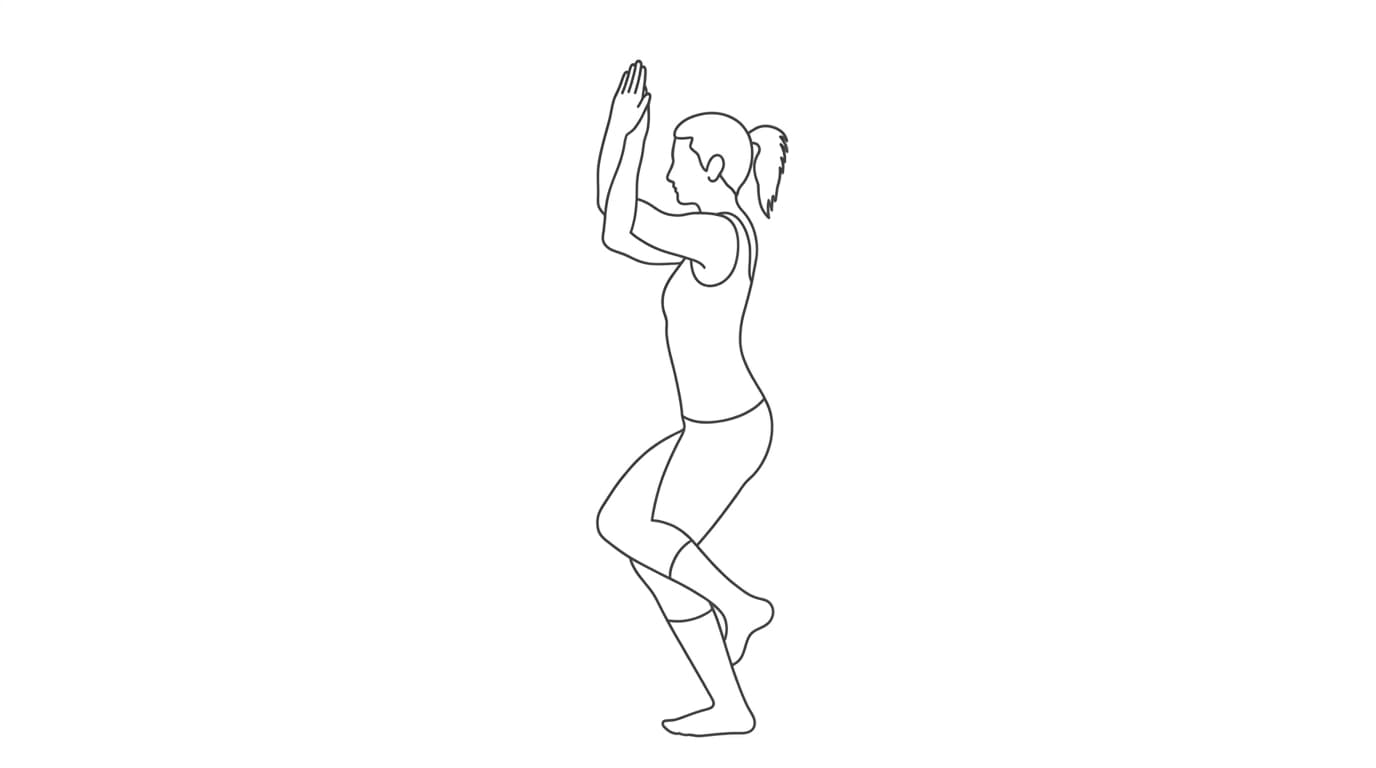
Eagle Pose combines a standing balance with crossed legs and arms. The leg wrap and arm bind are optional; keep one foot on the floor and use a wall or chair if balance is uncertain.
What is Eagle Pose?
Garudasana is commonly taught as a standing balance with the legs and arms crossing. The full wraps are not required; simpler arm or leg positions are valid ways to explore the shape.
How do you practice a supported version?
Stand near a wall or chair and keep a soft standing knee.
- Begin in Mountain Pose with one hand near a wall or chair.
- Cross one thigh over the other only as far as comfortable. Keep the lower toes on the floor if needed.
- Keep the hands on the hips, or cross the arms loosely in front of the chest if the shoulders allow.
- Stay briefly while breathing easily, then uncross slowly and switch sides.
What alignment cues can help?
- Keep the standing foot steady and gaze at a fixed point.
- Avoid forcing the knees or ankles into a tight wrap.
- Keep the shoulders relaxed; the arm bind is optional.
How can you modify Eagle Pose?
- Use a toe kickstand instead of wrapping the lifted leg.
- Hold a chair or wall.
- Practice only the arm position while standing comfortably.
When should you stop or modify?
Use support for balance concerns and avoid forced knee or shoulder positions. Stop for joint pain, numbness, or dizziness. This is an educational draft pending teacher review.
Common question: Do the arms have to bind?
No. Keep the arms relaxed or use a comfortable cross-arm position without forcing the shoulders.
Referenties en verdere lectuur
Deze referenties bieden algemene context. Ze valideren niet elke aanwijzing op deze pagina en vervangen geen instructie van een gekwalificeerde leraar.
- Yoga: Effectiveness and Safety National Center for Complementary and Integrative Health (NCCIH). General context on yoga safety and balance modifications.