
Warrior I is a standing lunge with the feet grounded and the torso facing generally forward. Stance length, back-foot angle, and knee bend can be adjusted; the arms may stay on the hips.
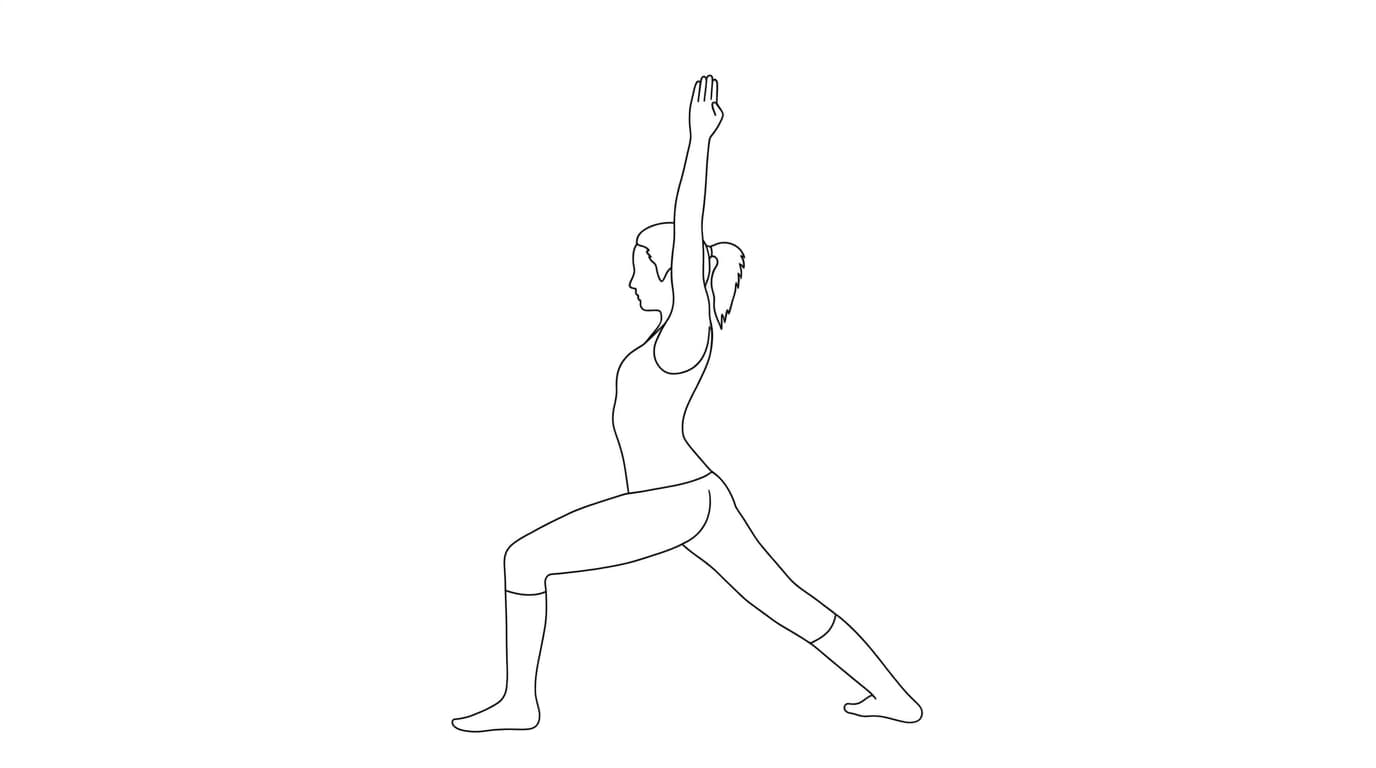
What is Warrior I?
Virabhadrasana I is one of several postures named for the warrior Virabhadra. Modern teachers use different foot angles and stance lengths, so treat the shape as adaptable rather than fixed.
How do you practice Warrior I?
Stand on a non-slip surface and shorten the stance until both feet feel stable.
- Step one foot back and turn it outward slightly, keeping the whole foot grounded if comfortable.
- Bend the front knee a modest amount, keeping it oriented in the same general direction as the toes.
- Let the torso face forward only as far as the hips and back comfortably allow.
- Keep the hands on the hips or raise the arms if the shoulders allow without arching the back.
- Straighten the front leg, step forward, and change sides.
What alignment cues can help?
- Shorten the stance if the pelvis twists or the back foot becomes unstable.
- Keep the front knee soft and supported by the foot.
- Avoid forcing the hips to face directly forward.
How can you modify Warrior I?
- Use a shorter stance and shallow knee bend.
- Keep the hands on the hips or hold a chair for balance.
- Practice with the back heel lifted if grounding it strains the ankle or hip.
When should you stop or modify?
Stop for sharp joint or back pain, dizziness, or loss of balance. Adapt for knee, hip, ankle, or shoulder concerns; this draft awaits teacher review.
Common question: Must the back heel stay down?
No. Adjust the heel and stance to a stable, comfortable position.
Quellen und weiterführende Literatur
Diese Referenzen bieten allgemeinen Kontext. Sie bestätigen nicht jeden einzelnen Hinweis auf dieser Seite und ersetzen keinen Unterricht bei qualifizierten Lehrkräften.
- Yoga: Effectiveness and Safety National Center for Complementary and Integrative Health (NCCIH). General context on yoga safety and adapting postures; not pose-specific instruction.