
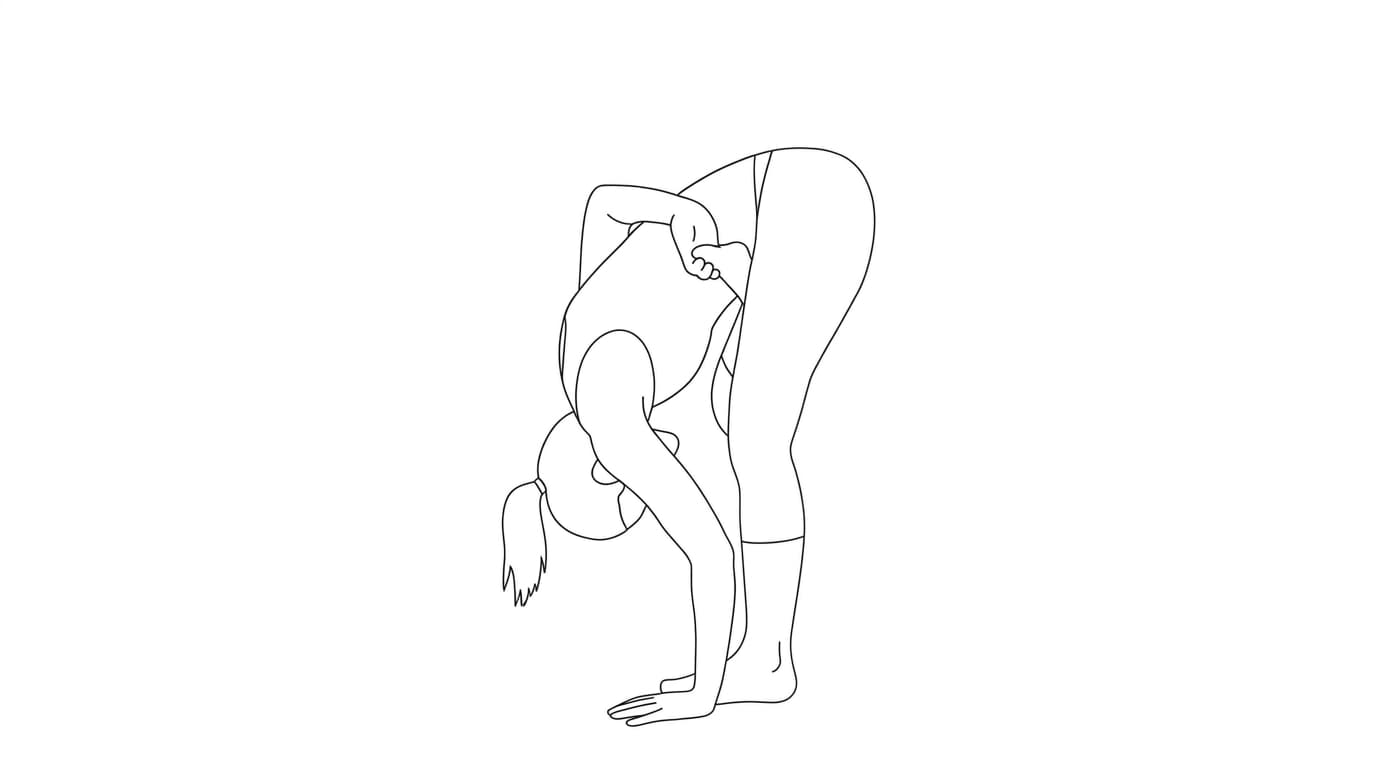
Standing Half Bound Lotus Forward Bend combines a one-legged balance, a lotus-style leg position, a bind, and a forward fold. This is demanding on the knee and balance; do not force the lotus leg or learn the full entry from text alone.
What is Standing Half Bound Lotus Forward Bend?
Ardha Baddha Padmottanasana is an advanced standing variation combining a half-lotus leg position with a forward fold and arm bind. The knee should never be twisted to create the lotus shape.
How should this pose be approached?
Learn the specific version in person from a qualified teacher. This page does not provide an entry sequence for the full bind.
- Do not pull the foot into lotus or use the knee as a hinge.
- Keep the standing balance supported during any preparation.
- Release the bind before changing position if balance shifts.
- Stop for knee, hip, or ankle pain, numbness, or instability.
What is a lower-demand alternative?
Practice a supported standing fold with both feet grounded, or a simple standing balance without a lotus leg or bind.
Common question: Is lotus leg position safe to force if the hip is tight?
No. Forcing rotation through the knee can be harmful; use a different posture and seek individualized instruction.
Références et lectures complémentaires
Ces références fournissent un contexte général. Elles ne valident pas chaque indication de cette page et ne remplacent pas les conseils d’un enseignant qualifié.
- Yoga: Effectiveness and Safety National Center for Complementary and Integrative Health (NCCIH). General context on yoga safety; not pose-specific instruction or endorsement.