
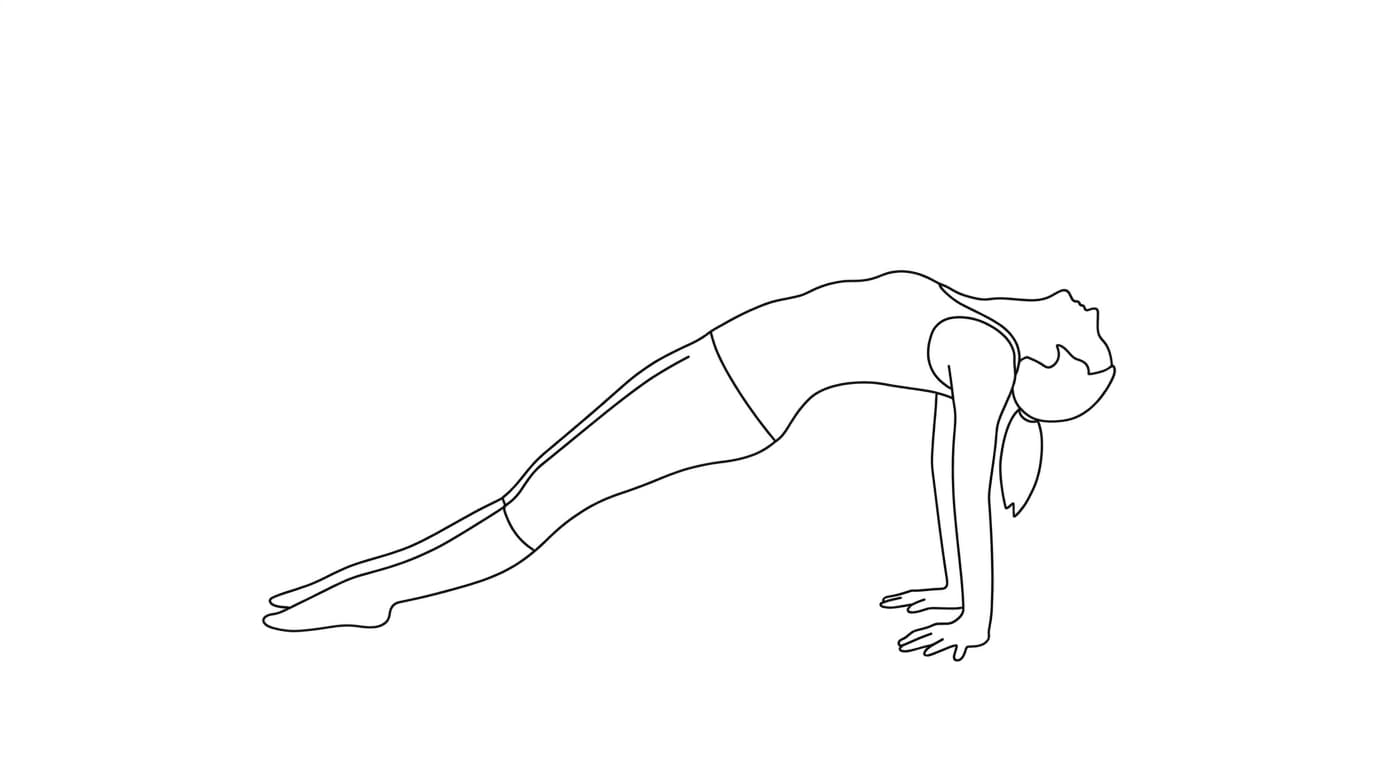
Upward Plank is a seated reverse-support posture that can load the wrists and shoulders. Begin with a small supported chest lift and knees bent; the hips do not need to rise into a full plank.
What is Upward Plank?
Purvottanasana is a seated reverse-support posture with the hands behind the body. Full hip lifting can be demanding, and a smaller chest-opening movement is a valid adaptation.
How do you explore a low-range variation?
Sit with the knees bent and feet grounded on a non-slip surface.
- Place the hands behind the hips at a distance that is comfortable for the shoulders.
- Keep the fingers oriented in a comfortable direction and soften the elbows.
- Press lightly through the feet and hands to lift the chest a small amount; hips may remain on the floor.
- Keep the neck neutral and breathe normally.
- Lower the torso before the arms become strained.
How can you modify Upward Plank?
Keep the hips down, bend the knees, place the hands on blocks, or practice a seated chest-opening movement without bearing weight.
When should you stop or modify?
Stop for wrist, shoulder, elbow, or back pain, numbness, or breath restriction. This draft awaits qualified review.
Common question: Do the hips need to lift high?
No. A supported chest lift can be enough.
Références et lectures complémentaires
Ces références fournissent un contexte général. Elles ne valident pas chaque indication de cette page et ne remplacent pas les conseils d’un enseignant qualifié.
- Yoga: Effectiveness and Safety National Center for Complementary and Integrative Health (NCCIH). General context on yoga safety and adapting postures; not pose-specific instruction.