
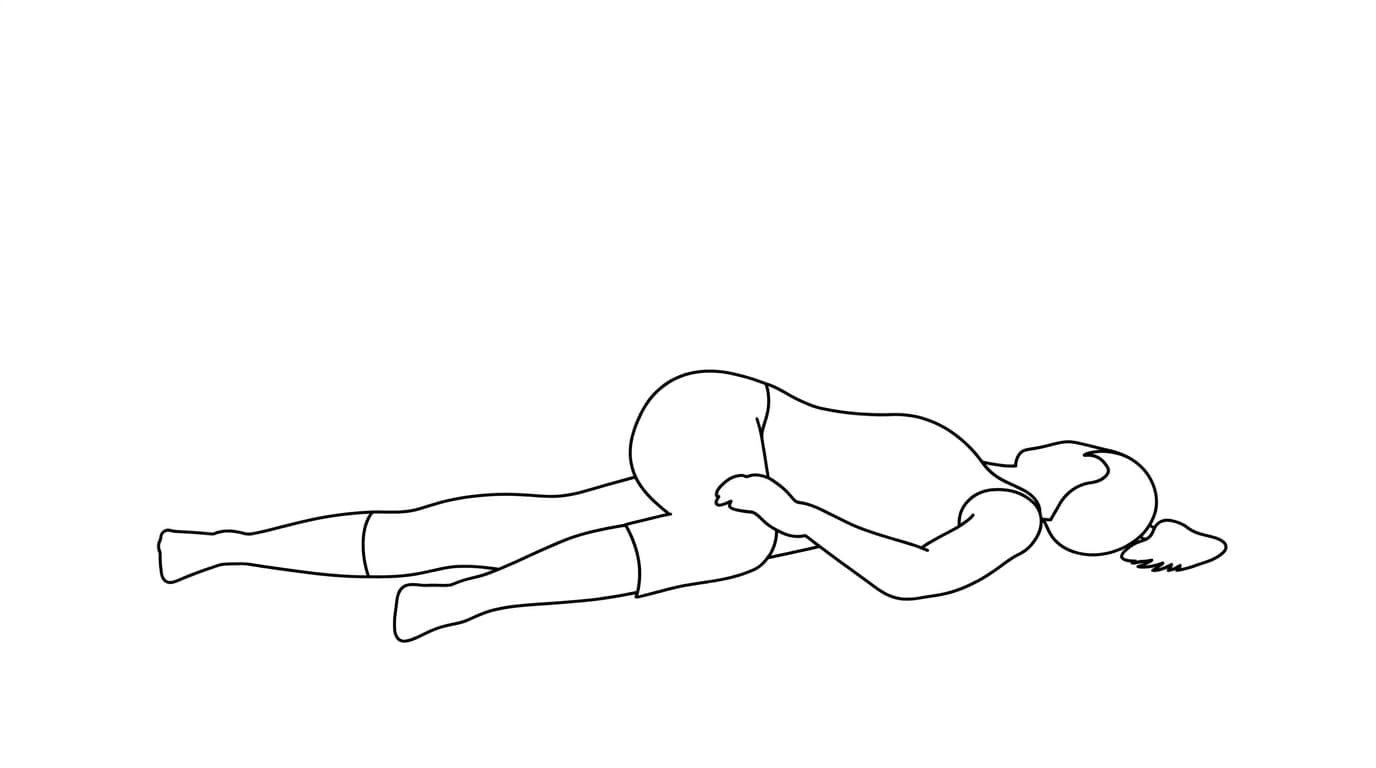
Supine Spinal Twist is a reclined rotation with the knees bent. Let the legs move only as far as the back remains comfortable; support the knees with a cushion and keep the shoulders relaxed rather than forcing them to the floor.
What is Supine Spinal Twist?
Supta Matsyendrasana is commonly taught lying on the back with the knees bent and moving to one side. The range can be very small, and the arms can remain beside the body.
How do you explore a gentle twist?
Lie on a padded surface and keep both shoulders comfortable.
- Bend the knees with the feet resting on the floor.
- Move the knees a small distance to one side, stopping before the lower back or hips feel strained.
- Place a cushion beneath the knees if they do not rest comfortably.
- Keep the head facing upward, or turn it only if the neck remains relaxed.
- Return the knees to center and repeat on the other side.
How can you modify the twist?
Use a smaller range, support the legs with pillows, or keep the feet grounded and knees together. Arms may stay at the sides.
When should you stop or modify?
Stop for sharp back, hip, or knee pain, numbness, or dizziness. Do not press the knees toward the floor. This draft awaits qualified teacher review.
Common question: Do both shoulders need to stay on the floor?
No. Let the shoulders rest naturally; do not force them down to increase the twist.
Références et lectures complémentaires
Ces références fournissent un contexte général. Elles ne valident pas chaque indication de cette page et ne remplacent pas les conseils d’un enseignant qualifié.
- Yoga: Effectiveness and Safety National Center for Complementary and Integrative Health (NCCIH). General context on yoga safety and adapting postures; not pose-specific instruction.