
Revolved Standing Hand to Big Toe combines a one-legged balance, leg extension, and torso rotation. Use a wall and strap only with suitable instruction; keep the standing foot supported and do not force the lifted leg or twist.
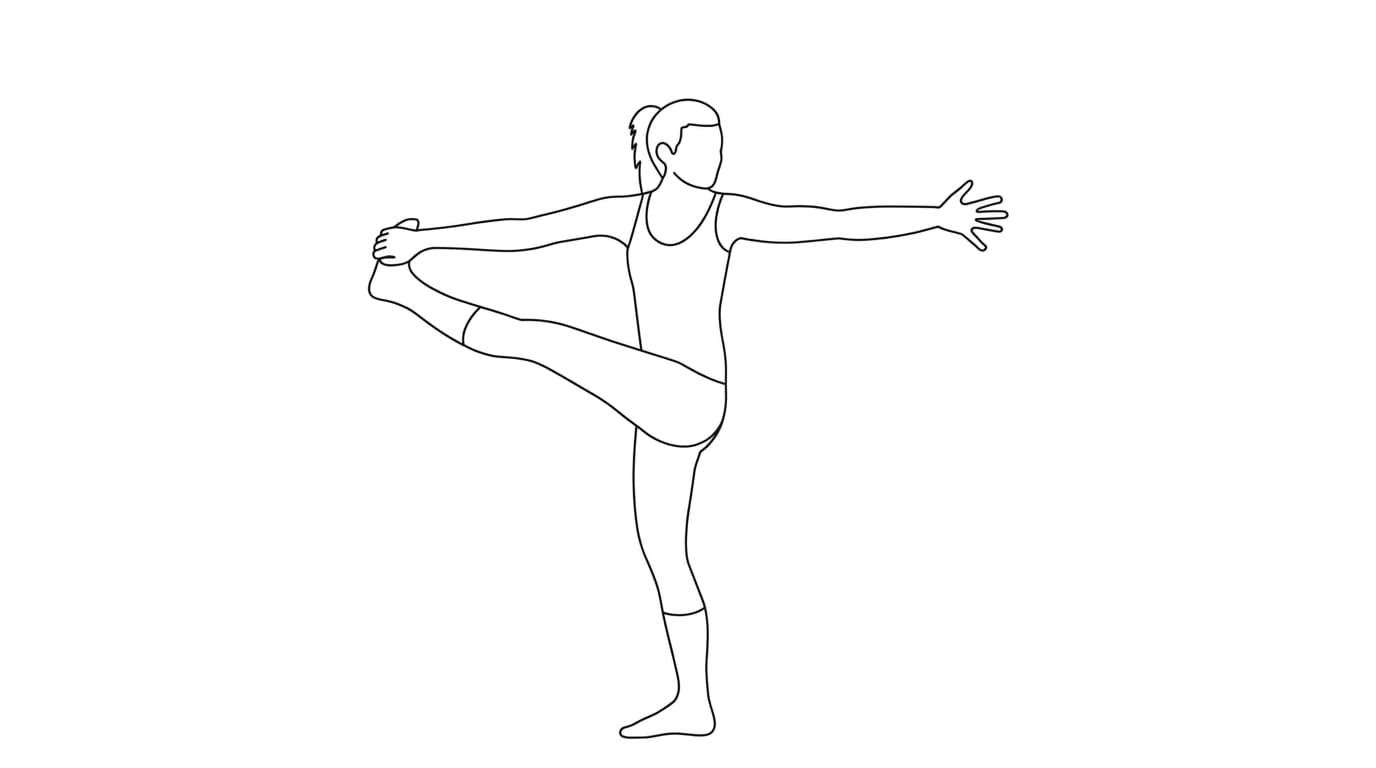
What is Revolved Standing Hand to Big Toe?
Parivritta Hasta Padangushthasana is a challenging standing balance with rotation. The name describes several demands at once; it should not be treated as a beginner pose or learned from a written entry sequence.
How should this posture be approached?
Work with a qualified teacher who can verify the version and provide balance support. This article intentionally does not prescribe entry steps.
- Use a wall or stable support when exploring the balance.
- Keep the lifted leg lower and the knee softer rather than forcing extension.
- Avoid pulling on a strap or twisting to reach a target.
- Return to two feet before releasing the support.
What is a gentler alternative?
Practice a two-foot standing twist or a supported Hand to Big Toe variation without rotation. A chair-supported balance may also be more appropriate.
When should you stop or seek instruction?
Do not attempt the unsupported full pose if balance, hip mobility, or twisting range is uncertain. Stop for pain, dizziness, or instability. This draft needs qualified review.
Common question: Is the full bind required?
No. A support-based variation or simpler balance is preferable to forcing the full shape.
Referências e leituras adicionais
Estas referências fornecem contexto geral. Elas não validam todas as orientações desta página nem substituem a instrução de um professor qualificado.
- Yoga: Effectiveness and Safety National Center for Complementary and Integrative Health (NCCIH). General context on yoga safety and balance modifications; not pose-specific instruction.