
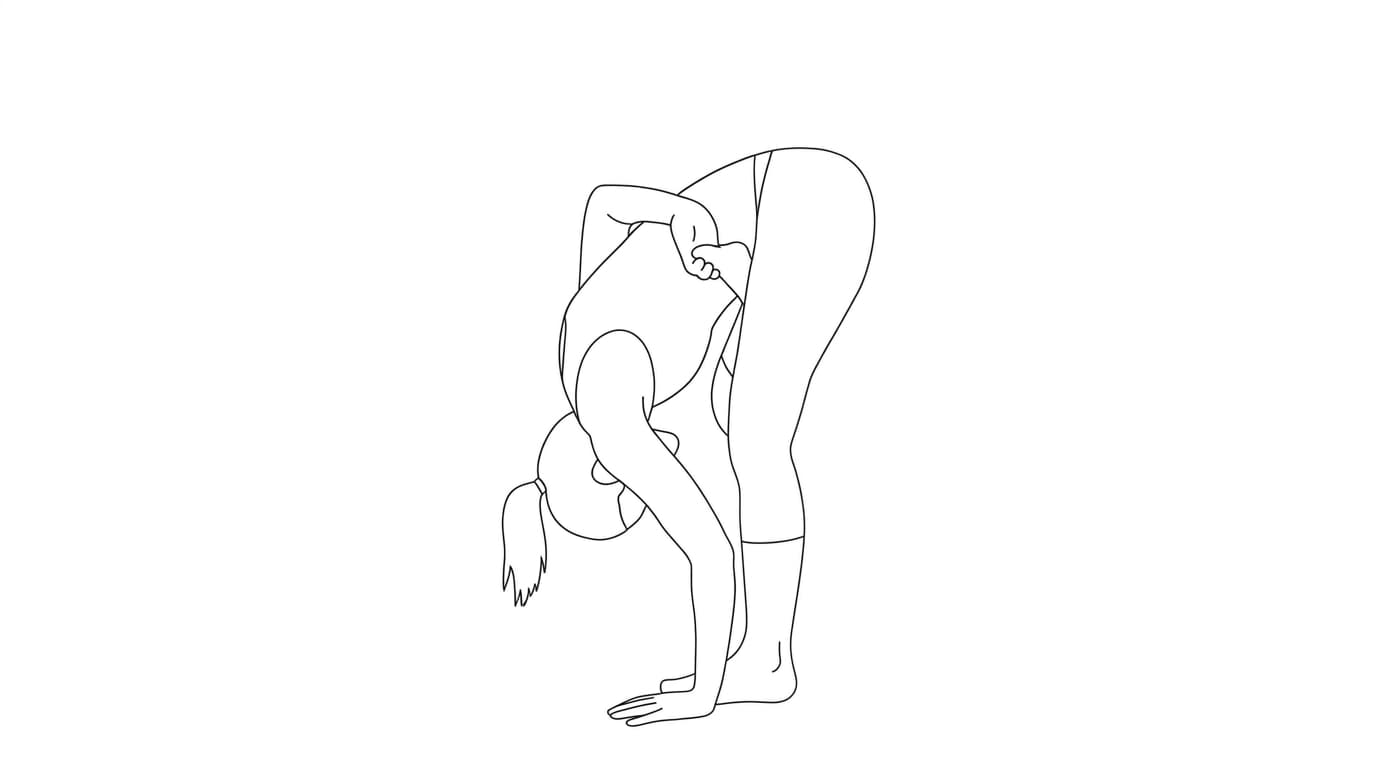
Standing Half Bound Lotus Forward Bend combines a one-legged balance, a lotus-style leg position, a bind, and a forward fold. This is demanding on the knee and balance; do not force the lotus leg or learn the full entry from text alone.
What is Standing Half Bound Lotus Forward Bend?
Ardha Baddha Padmottanasana is an advanced standing variation combining a half-lotus leg position with a forward fold and arm bind. The knee should never be twisted to create the lotus shape.
How should this pose be approached?
Learn the specific version in person from a qualified teacher. This page does not provide an entry sequence for the full bind.
- Do not pull the foot into lotus or use the knee as a hinge.
- Keep the standing balance supported during any preparation.
- Release the bind before changing position if balance shifts.
- Stop for knee, hip, or ankle pain, numbness, or instability.
What is a lower-demand alternative?
Practice a supported standing fold with both feet grounded, or a simple standing balance without a lotus leg or bind.
Common question: Is lotus leg position safe to force if the hip is tight?
No. Forcing rotation through the knee can be harmful; use a different posture and seek individualized instruction.
参考文献与扩展阅读
这些参考文献提供一般背景信息。它们并不验证本页中的每一项要领,也不能替代合格教师的指导。
- Yoga: Effectiveness and Safety National Center for Complementary and Integrative Health (NCCIH). General context on yoga safety; not pose-specific instruction or endorsement.