
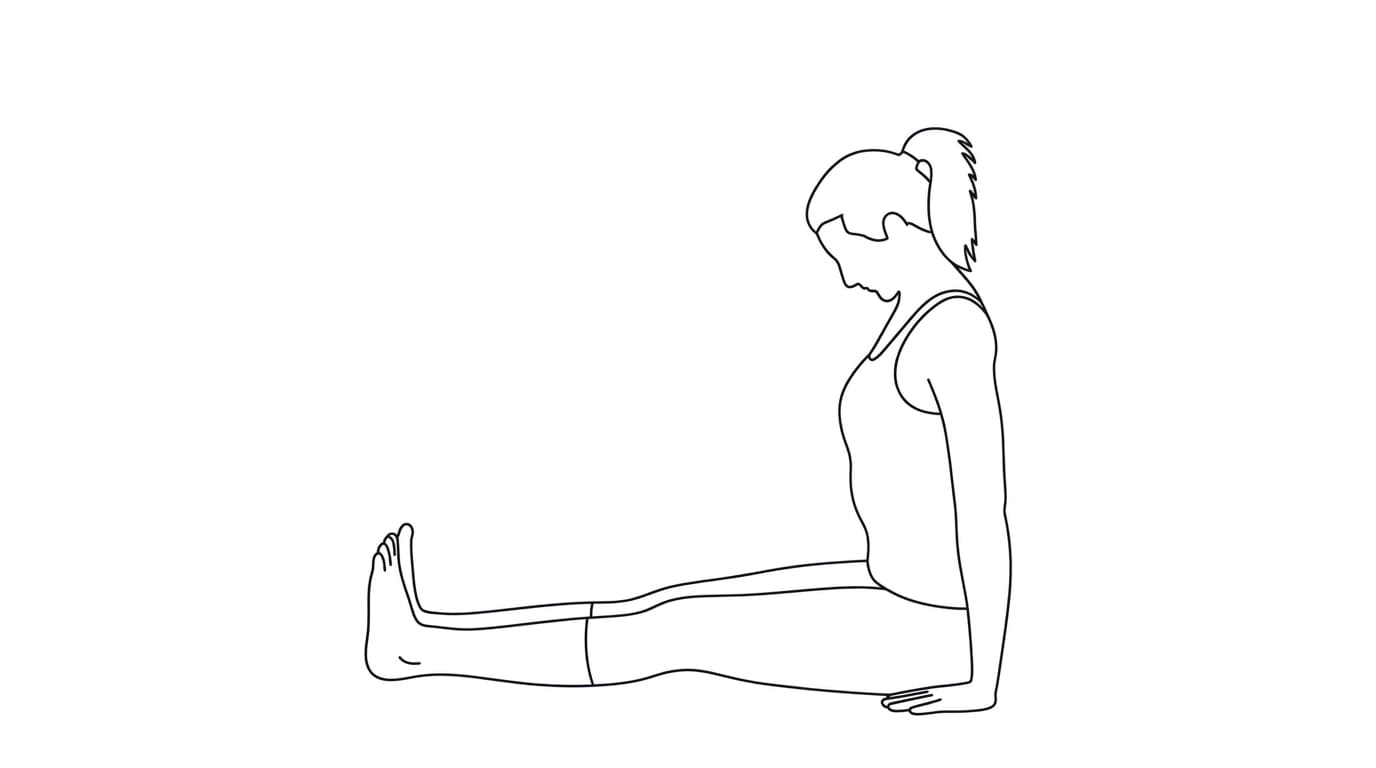
Staff Pose is a seated position with the legs extended in front. Bend the knees or sit on support if keeping the legs straight makes the back round or strains the knees; the shape is a starting point, not a flexibility test.
What is Staff Pose?
Dandasana is a seated posture with the legs reaching forward. It is often used as a starting position for other seated movements, but the knees can remain bent when that is more comfortable.
How do you practice Staff Pose?
Sit on a firm surface with enough room to extend the legs. A folded blanket can raise the hips.
- Extend the legs in front, leaving a small natural bend in the knees if needed.
- Place the hands beside the hips or on blocks; avoid forcing the shoulders downward to straighten the arms.
- Adjust the seat height until the torso can remain comfortably upright.
- Keep the feet relaxed and breathe normally for a few breaths.
- Bend the knees and move slowly when leaving the position.
What alignment cues can help?
- Keep the back comfortable rather than forcing the spine into a rigid vertical line.
- Use a modest leg extension; the knees do not need to lock.
- Place a cushion beneath the knees if they feel unsupported.
How can you modify Staff Pose?
Sit in a chair with the feet on the floor, or keep the knees bent over a bolster. If the floor seat strains the back, use a wall for support.
When should you stop or modify?
Adjust for back, knee, or hamstring discomfort, and stop for sharp pain, numbness, or tingling. This guide is general education and has not been reviewed by a named teacher.
Common question: Do the legs need to be perfectly straight?
No. Keeping the knees slightly bent is a useful adaptation and does not invalidate the posture.
Referências e leituras adicionais
Estas referências fornecem contexto geral. Elas não validam todas as orientações desta página nem substituem a instrução de um professor qualificado.
- Yoga: Effectiveness and Safety National Center for Complementary and Integrative Health (NCCIH). General context on yoga safety and adapting postures; not pose-specific instruction.