
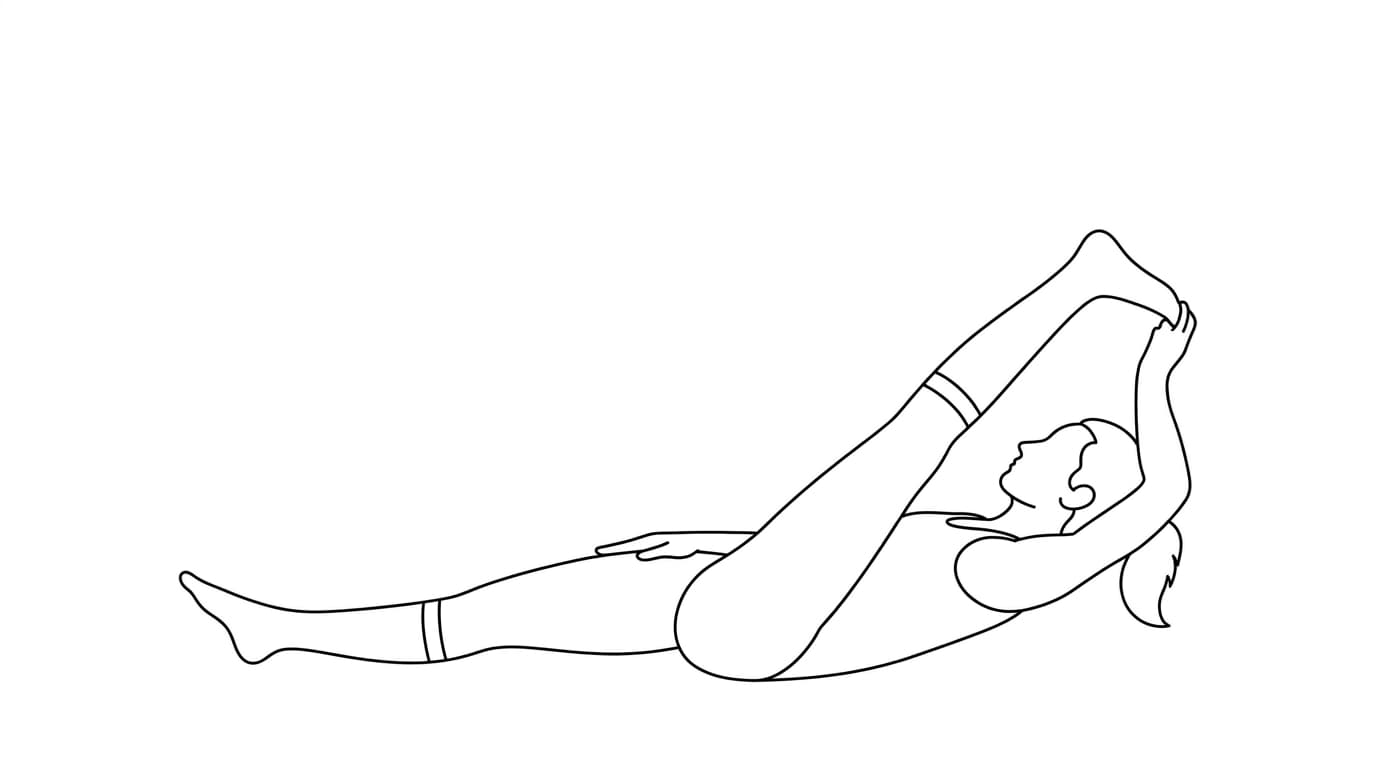
Supine Hand to Big Toe is a reclined leg-extension posture, often practiced with a strap around the lifted foot. Keep the opposite leg comfortable and the lifted knee slightly bent if needed; the leg does not need to approach vertical.
What is Supine Hand to Big Toe?
Supta Padangushthasana A is commonly taught lying down while one leg extends upward. A strap can provide reach without pulling the leg toward the torso.
How do you practice a supported version?
Lie on the back with a strap or towel available; keep the neck relaxed.
- Bend both knees and place the feet on the floor.
- Bring one knee toward the torso and loop a strap around the foot, holding both ends comfortably.
- Slowly extend the leg only as far as the back and hamstrings remain comfortable; a bent knee is fine.
- Keep the opposite foot grounded or its knee bent, and avoid pulling hard on the strap.
- Bend the lifted knee before lowering the foot, then switch sides.
How can you modify the leg extension?
Keep the knee bent, use a longer strap, or practice with both feet supported and no lift. The lifted leg may angle away from the torso if that feels easier.
When should you stop or modify?
Stop for sharp hip, back, or knee pain, numbness, or tingling. This draft is not individualized instruction and awaits teacher review.
Common question: Does the leg have to be straight?
No. A softly bent knee is a valid adaptation.
Referências e leituras adicionais
Estas referências fornecem contexto geral. Elas não validam todas as orientações desta página nem substituem a instrução de um professor qualificado.
- Yoga: Effectiveness and Safety National Center for Complementary and Integrative Health (NCCIH). General context on yoga safety and adapting postures; not pose-specific instruction.