
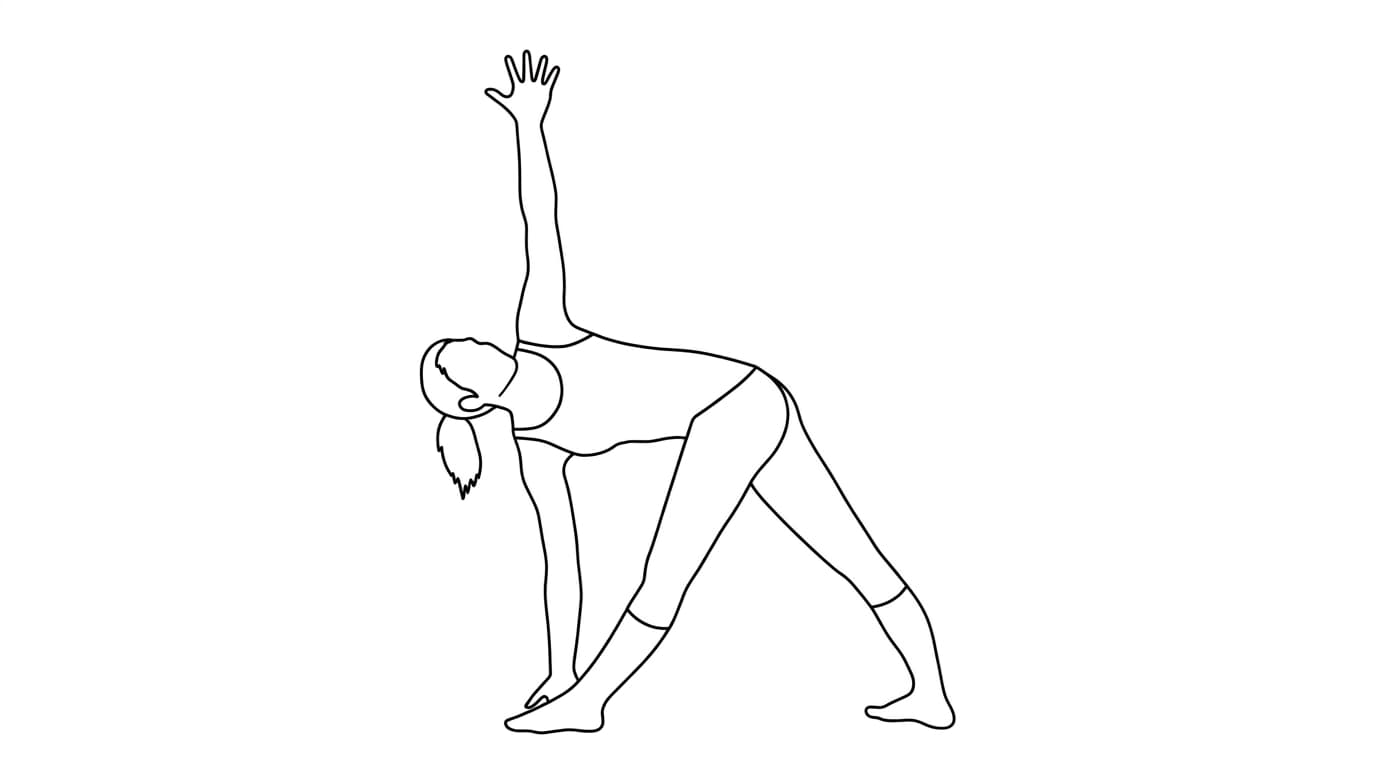
Revolved Triangle is a standing pose with a forward hinge and gentle torso rotation. Use a wall or block, shorten the stance, and keep the rotation modest; the hand need not reach the floor and the neck need not turn upward.
What is Revolved Triangle?
Parivritta Trikonasana combines an asymmetric stance with a forward hinge and rotation. Teachers differ on stance width and foot angle; the twist can remain small.
How do you explore a supported version?
Use blocks or a chair and keep the stance shorter than a full lunge.
- Step one foot forward and the other back with enough side-to-side width for balance.
- Keep the front knee soft and place the opposite hand on a block, chair, or front thigh.
- Lengthen the torso forward slightly, then rotate only a small amount if comfortable.
- Keep the gaze down or forward rather than turning the neck upward.
- Return the hand to support, rise slowly, and change sides.
How can you modify Revolved Triangle?
Bend the front knee, shorten the stance, raise the hand support, and reduce the rotation. Keep the upper hand on the hip.
When should you stop or modify?
Stop for sharp back, knee, or hip pain, dizziness, or numbness. Do not lever the twist with the arm. This draft awaits teacher review.
Common question: Does the lower hand have to touch the floor?
No. A block, chair, or thigh support is suitable.
参考文献与扩展阅读
这些参考文献提供一般背景信息。它们并不验证本页中的每一项要领,也不能替代合格教师的指导。
- Yoga: Effectiveness and Safety National Center for Complementary and Integrative Health (NCCIH). General context on yoga safety and adapting postures; not pose-specific instruction.