
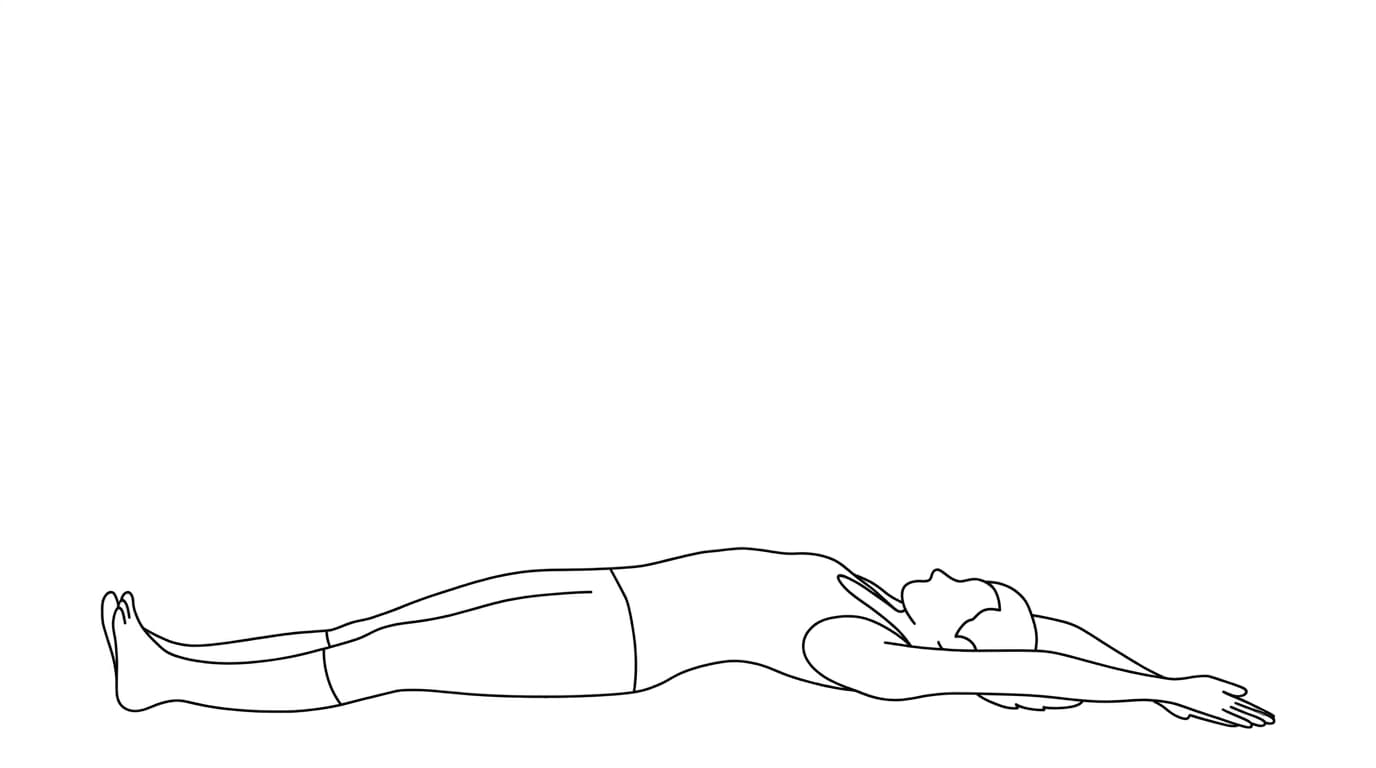
Banana Pose is a reclined side-body stretch with the legs and arms curving to one side. Keep both shoulders and hips supported, make the curve small, and use a cushion under the knees if the back or outer hip feels strained.
What is Banana Pose?
Supta Nitambasana, often called Banana Pose, is a supine side-body stretch. The shape can be subtle; the arms and legs do not need to reach far to one side.
How do you set up a gentle version?
Lie on a padded surface with room to move both arms and legs.
- Begin on the back with the arms resting beside the body and legs comfortable.
- Move the feet a small distance to one side while keeping the pelvis supported.
- Move the arms overhead only if the shoulders remain comfortable.
- Keep the head neutral and breathe normally for a few breaths.
- Return to center slowly and change sides.
How can you modify Banana Pose?
Keep the arms beside the body, bend the knees, or place a cushion beneath them. Reduce the side curve if there is pulling in the back or hips.
When should you stop or modify?
Stop for sharp back, hip, shoulder, or neck pain, numbness, or breathing restriction. This draft awaits teacher review.
Common question: Do the hands and feet need to touch?
No. Keep a comfortable curve with the body supported.
参考文献与扩展阅读
这些参考文献提供一般背景信息。它们并不验证本页中的每一项要领,也不能替代合格教师的指导。
- Yoga: Effectiveness and Safety National Center for Complementary and Integrative Health (NCCIH). General context on yoga safety and adapting postures; not pose-specific instruction.