
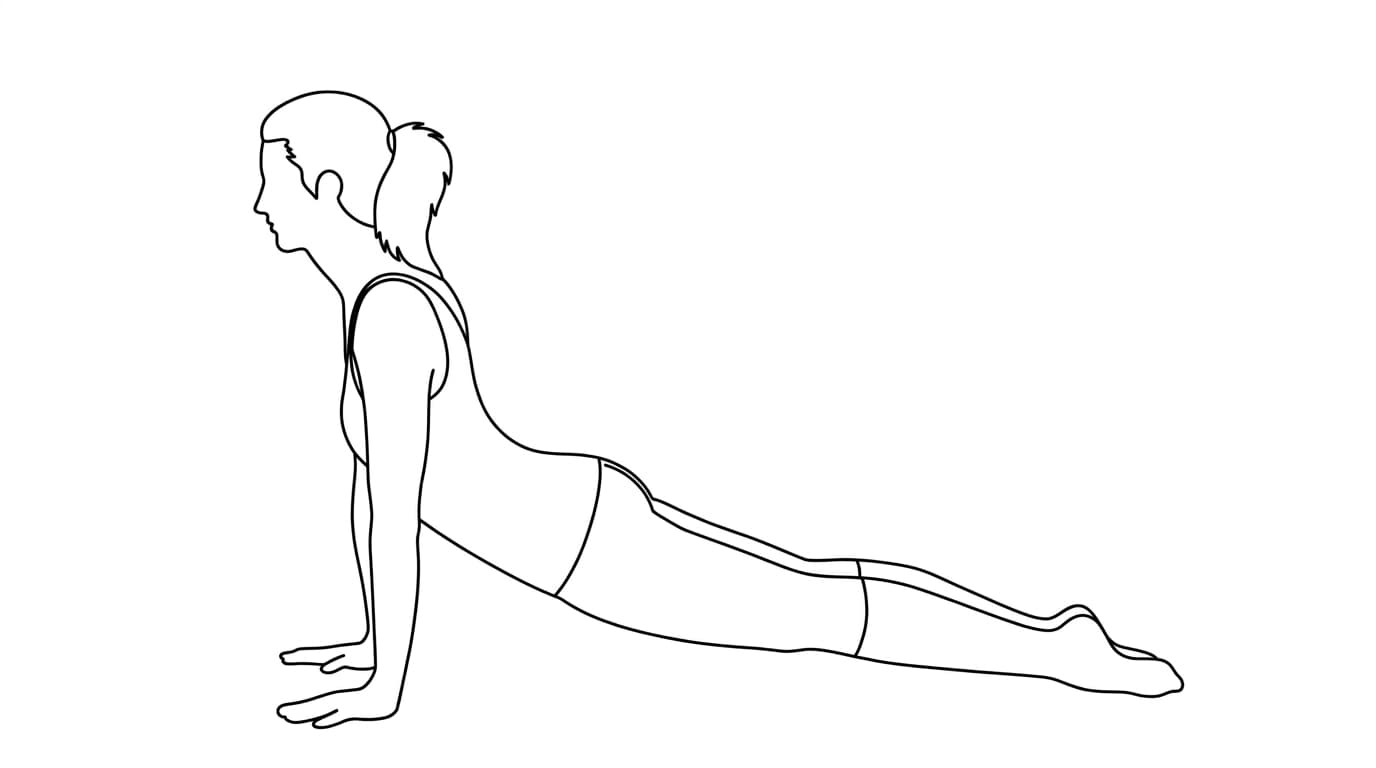
Upward-Facing Dog is an arm-supported backbend in which the torso lifts while the legs remain active. It can strain wrists, shoulders, or the lower back; use Cobra Pose or keep the thighs down if lifting is uncomfortable.
What is Upward-Facing Dog?
Urdhva Mukha Shvanasana is a backbend supported through the hands and feet. It differs from Cobra Pose, where the pelvis and legs remain on the floor; choose the version that suits your practice.
How should the posture be approached?
Learn the transition and alignment with qualified instruction, especially if it is part of a flowing sequence.
- Keep the shoulders away from forced end range.
- Press through the hands only if the wrists feel comfortable.
- Avoid compressing the lower back to lift the chest higher.
- Lower to the floor or choose Cobra if the support feels strained.
How can you modify Upward-Facing Dog?
Keep the thighs down for Cobra Pose, lower the chest, or place the hands on blocks only under teacher guidance. Do not force the hips off the floor.
When should you stop or modify?
Stop for wrist, shoulder, or back pain, numbness, or breath restriction. This draft awaits teacher review.
Common question: Is Upward-Facing Dog the same as Cobra?
No. They are distinct shapes with different points of support.
参考文献与扩展阅读
这些参考文献提供一般背景信息。它们并不验证本页中的每一项要领,也不能替代合格教师的指导。
- Yoga: Effectiveness and Safety National Center for Complementary and Integrative Health (NCCIH). General context on yoga safety and adapting postures; not pose-specific instruction.