
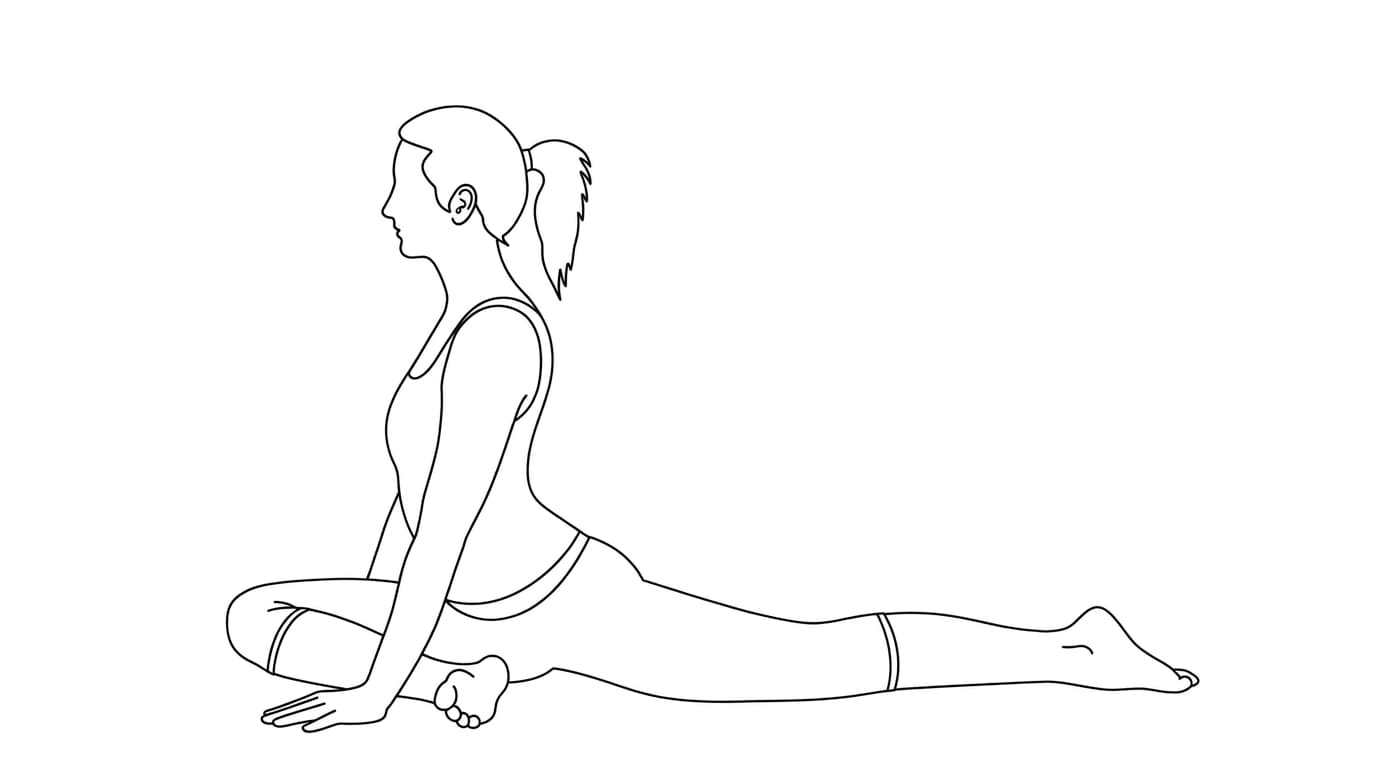
Half Pigeon is a floor posture with one leg forward and the other extended behind. It can load the front hip and knee, so keep the pelvis supported and choose a reclined or supine alternative if the knee feels pressure.
What is Half Pigeon?
Ardha Kapotasana is a hip-focused floor posture taught in several modern yoga styles. Its name and shape vary between lineages; this page describes a gentle supported variation, not a requirement to fold deeply.
How do you explore a supported variation?
Use a folded blanket or cushion beneath the front-side hip and keep the range modest.
- Begin on hands and knees and bring one knee forward only as far as comfortable.
- Position the front foot where the knee feels uncompressed; the shin does not need to be parallel to the front edge of the mat.
- Extend the other leg behind only as far as the pelvis can remain supported.
- Keep the torso upright with hands on blocks. Do not lower forward unless the hip and knee remain comfortable.
- Return to hands and knees slowly and change sides, or choose a supine figure-four stretch instead.
How can you modify Half Pigeon?
Raise the front hip with a cushion, keep the torso upright, or use a supine figure-four position that does not press on the knee.
When should you stop or modify?
Stop for knee pain, pinching, numbness, or sharp hip discomfort. Do not force the front shin or press the pelvis downward. This draft awaits qualified review.
Common question: Does the front shin need to be parallel to the mat edge?
No. A comfortable shin angle and support under the hip are more important than a particular shape.
Referencias y lecturas adicionales
Estas referencias proporcionan un contexto general. No validan cada indicación de esta página ni reemplazan la instrucción de un maestro calificado.
- Yoga: Effectiveness and Safety National Center for Complementary and Integrative Health (NCCIH). General context on yoga safety and adapting postures; not pose-specific instruction.