
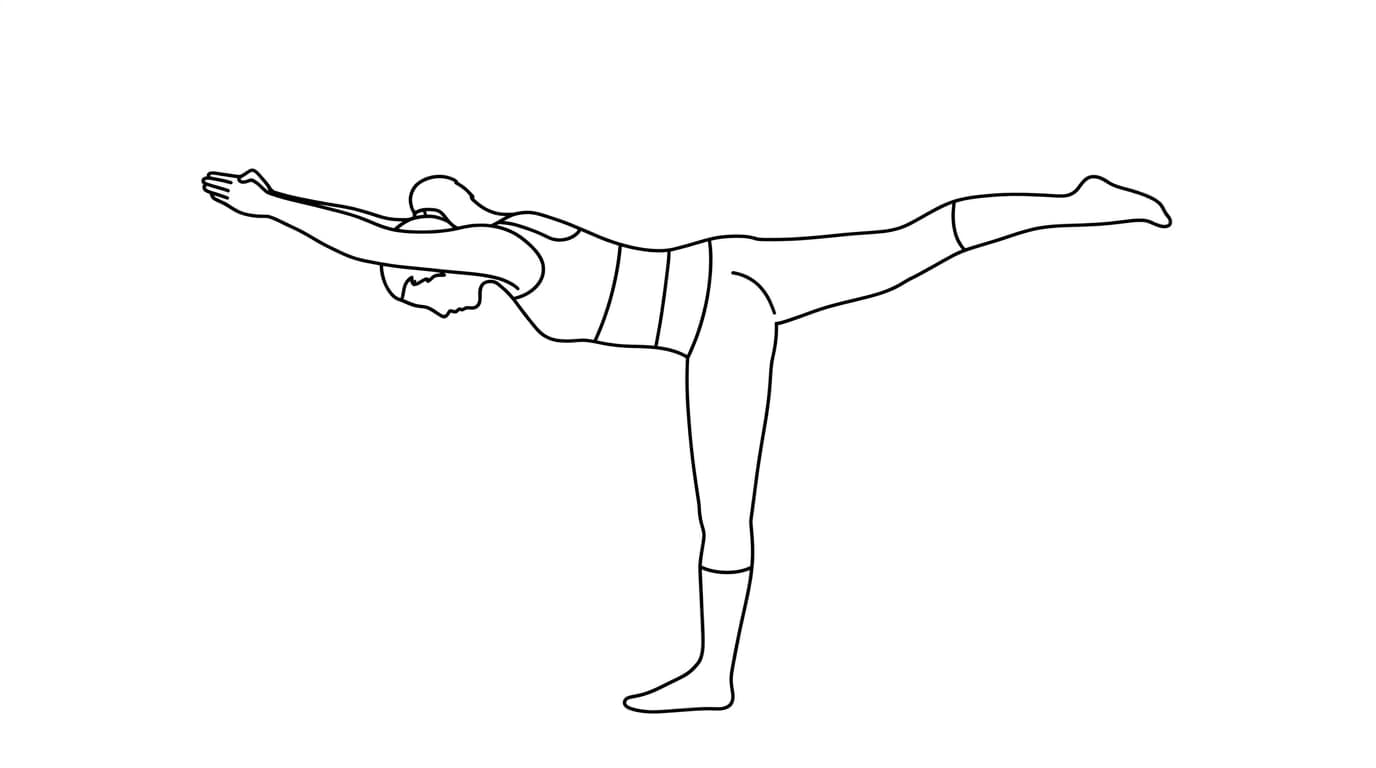
Warrior III is a standing balance in which the torso and one leg incline forward while the other leg supports the body. Use a wall or chair and keep the lifted leg low; balance and depth are optional.
What is Warrior III?
Virabhadrasana III is a one-legged balance with the torso inclining forward. The lifted leg does not need to reach hip height, and support is a useful part of practice.
How do you explore a supported Warrior III?
Practice beside a wall or sturdy chair and keep the range small.
- Stand in Mountain Pose and place both hands on the wall or chair.
- Shift weight into one foot while keeping the standing knee soft.
- Hinge the torso forward a little and slide the other foot back with its toes lightly touching the floor.
- If stable, float the back foot only slightly. Keep the support and lower the leg immediately if balance changes.
- Return upright using the support and switch sides.
What alignment cues can help?
- Keep the standing foot broad and grounded.
- Let the spine lengthen rather than rounding to lift the back leg.
- Keep the gaze down or forward without straining the neck.
How can you modify Warrior III?
- Keep the back toes on the floor as a kickstand.
- Use both hands on a wall or chair.
- Make the hinge and leg lift very small.
When should you stop or modify?
Do not practice near hard objects or without support if a fall could injure you. Stop for pain, dizziness, or instability. This draft needs a named yoga-teacher review.
Common question: Does the lifted leg need to be level with the hips?
No. A low lift or toe-supported balance is a valid starting point.
Referências e leituras adicionais
Estas referências fornecem contexto geral. Elas não validam todas as orientações desta página nem substituem a instrução de um professor qualificado.
- Yoga: Effectiveness and Safety National Center for Complementary and Integrative Health (NCCIH). General safety context for yoga and balance modifications.