
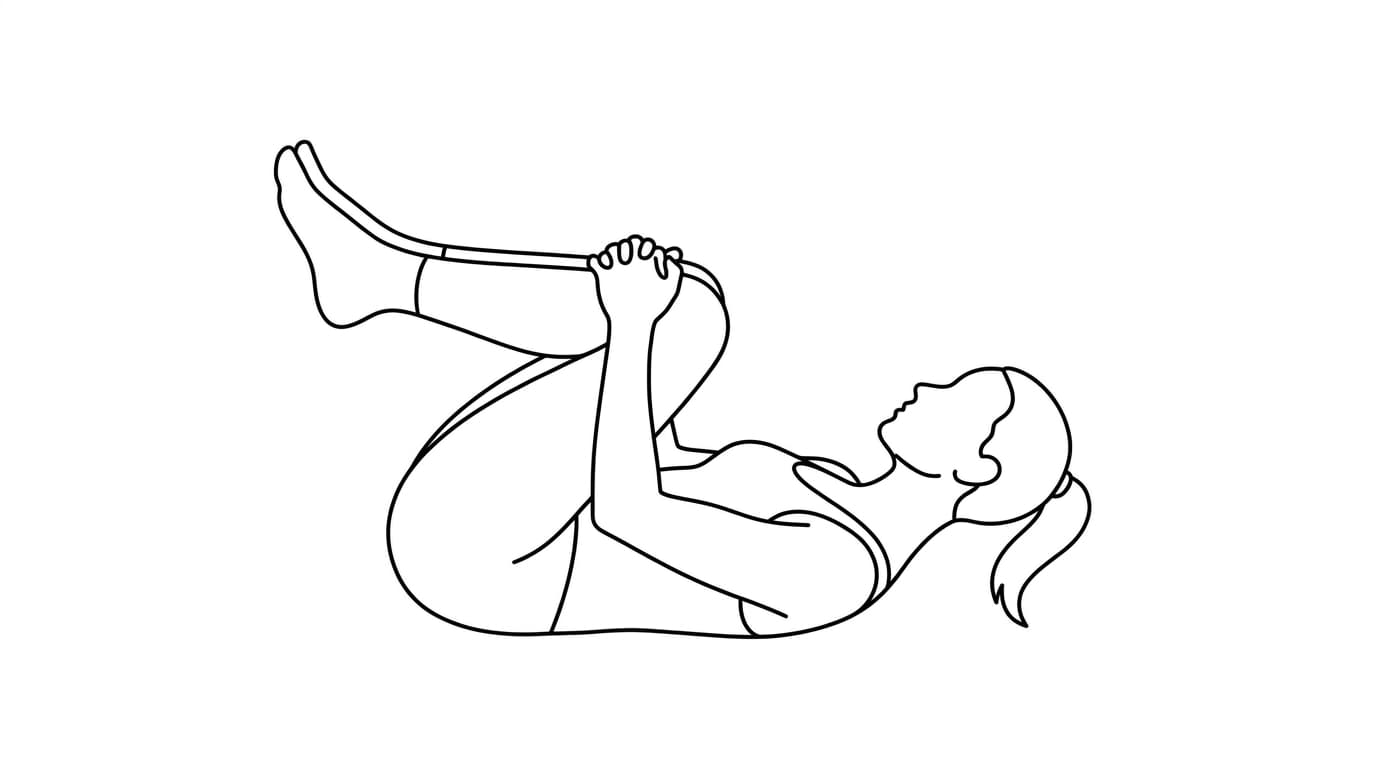
Wind-Removing Pose is a supine posture that brings one or both knees toward the torso. Keep the head resting on the floor and use only gentle arm support; there is no need to compress the abdomen or pull the knees tightly inward.
What is Wind-Removing Pose?
Pavanamuktasana is a reclined knees-to-chest posture. It may be practiced with one leg at a time or both knees together, depending on comfort.
How do you practice a gentle version?
Lie on a supportive surface with the head and shoulders relaxed.
- Bend one knee and bring it toward the torso only as far as comfortable.
- Hold behind the thigh or shin rather than pressing on the kneecap.
- Keep the other foot grounded or its knee bent if that is easier for the back.
- Breathe normally, then release the leg slowly and repeat on the other side.
- Bring both knees in only if that remains comfortable; the two-leg version is optional.
How can you modify the posture?
Keep one foot on the floor, hold behind the thigh, or place a cushion beneath the head. Use less compression if the abdomen or hips feel crowded.
When should you stop or modify?
Stop for sharp back, hip, or knee pain, dizziness, or breathing restriction. This draft is general education and awaits qualified review.
Common question: Must both knees come in together?
No. One leg at a time is a complete version.
संदर्भ और आगे पढ़ने के लिए
ये संदर्भ सामान्य पृष्ठभूमि देते हैं। ये इस पृष्ठ के हर निर्देश की पुष्टि नहीं करते और किसी योग्य शिक्षक के मार्गदर्शन का विकल्प नहीं हैं।
- Yoga: Effectiveness and Safety National Center for Complementary and Integrative Health (NCCIH). General context on yoga safety and adapting postures; not pose-specific instruction.